




Precision irrigation on golf courses: Mapping soil moisture with turfRad
Water has always been one of the most closely managed inputs on a golf course. Today, it is also one of the most scrutinized. Rising water costs, increasing regulation, aging infrastructure and heightened expectations around environmental stewardship have pushed superintendents toward more innovative, more targeted irrigation strategies.
Precision irrigation, applying water only where and when it is needed, has become the goal. The challenge has been getting reliable, high-resolution soil moisture data quickly enough to make that goal practical.
Our study, published in the International Turfgrass Society Research Journal, offers a significant step forward. At Texas A&M University and the University of California–Riverside, we evaluated a Portable L-band Radiometer (PoLRa), commercially known as turfRad, for mapping soil moisture across golf course fairways. The results suggest that this technology can deliver accurate, large-scale soil moisture maps at operational speeds when site-specific calibration is used.
For superintendents navigating the next generation of irrigation management, the findings provide both excitement and a dose of realism: turfRad works, but not as a plug-and-play solution.
Why fairway soil moisture mapping is hard
Most superintendents are already using soil moisture sensors in some form. Hand-held time domain reflectometry (TDR) probes, in-ground sensors and even mower-mounted systems are becoming commonplace. These tools have improved irrigation decisions, but they also come with limitations.
Hand-held probes provide accurate data, but they are point measurements. A superintendent may take dozens or hundreds of readings and still capture only a fraction of the variability across a fairway. Permanently installed sensors provide continuous monitoring, but they capture only soil conditions at a single location. Neither approach easily scales to whole-fairway mapping.
Precision irrigation, however, depends on understanding spatial variability. Research has repeatedly shown that soil moisture can vary dramatically within a single fairway due to differences in soil texture, organic matter, compaction, drainage, shade, slope and irrigation distribution. Without an efficient way to map that variability, superintendents are often forced to irrigate to the “wettest common denominator,” leading to overwatering in some areas and stress in others. This is the gap that turfRad is designed to fill.
How L-Band Radiometry Works
Unlike contact-based sensors, turfRad measures soil moisture using microwave radiometry. The sensor detects natural microwave emissions from the soil surface at a frequency of about 1.4 GHz, known as the L-band. This frequency is particularly sensitive to soil water content and can sense moisture roughly 4 inches (10 centimeters) below the surface, which aligns well with the active root zone of fairway turf.
Mounted on a mower or utility vehicle, the sensor collects data continuously as it moves across the fairway. The result is a dense, georeferenced dataset that can be converted into high-resolution soil moisture maps.
In theory, this solves several long-standing problems at once:
- No need for soil contact
- No stopping to take readings
- No single-point bias
- Rapid coverage of large areas
The big question has been whether the data is accurate enough for day-to-day irrigation decisions.
Golf course test of turfRad
To answer that question, we evaluated turfRad on three fairways at Champions Golf Club’s Jackrabbit Course in Houston. The fairways were planted with Tifway 419 bermudagrass growing on sandy loam soils, conditions familiar to many superintendents.
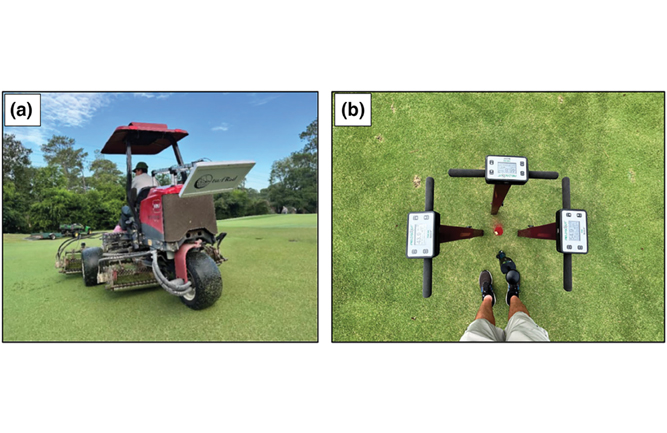
Data was collected over four periods spanning summer, winter, spring and early summer. The turfRad unit was mounted on a fairway mower and driven in multiple passes across each fairway (Figure 1a). At selected locations, researchers collected ground-truth soil moisture measurements using handheld TDR probes at multiple depths (Figure 1b). This allowed us to compare turfRad’s estimates with well-established soil moisture measurement techniques.
Off-the-shelf calibration: Promising but not enough
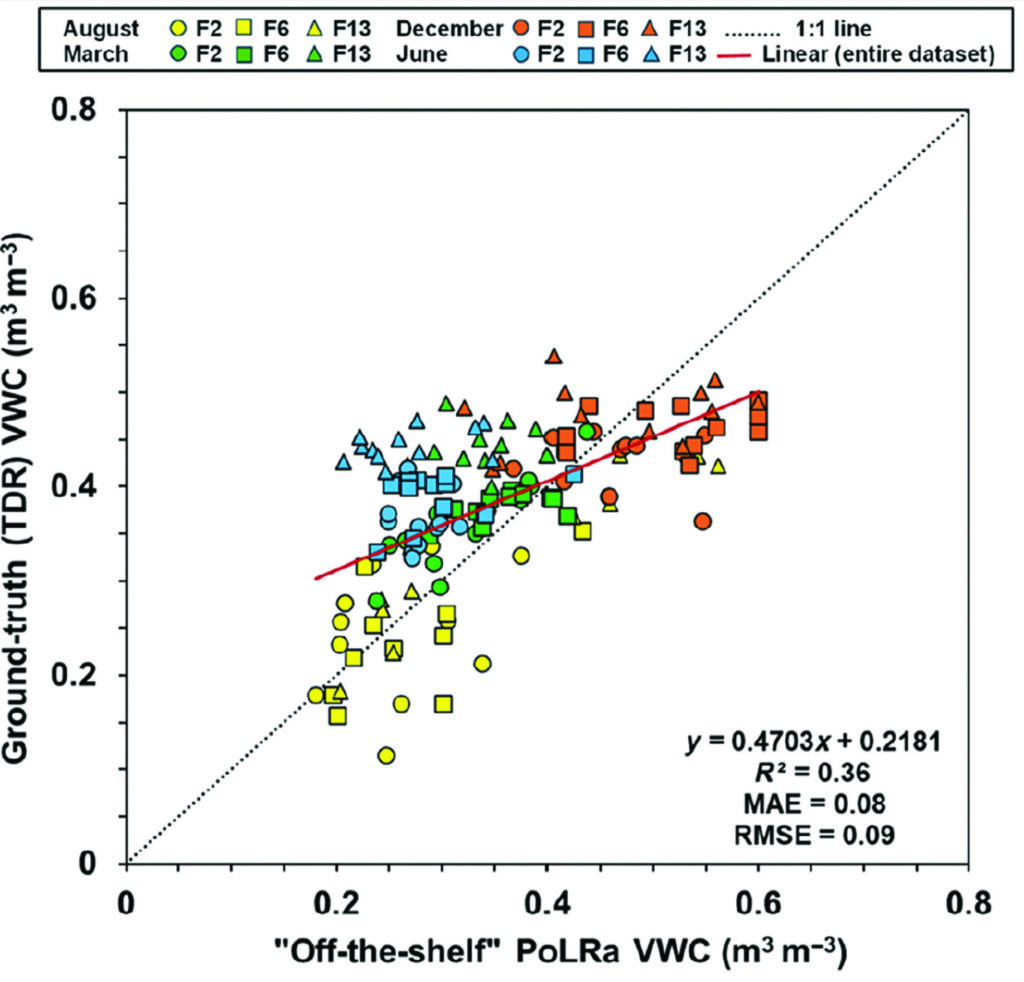
The first analysis tested turfRad using the manufacturer’s off-the-shelf calibration, essentially how the unit would perform if a superintendent installed it and started collecting data immediately.
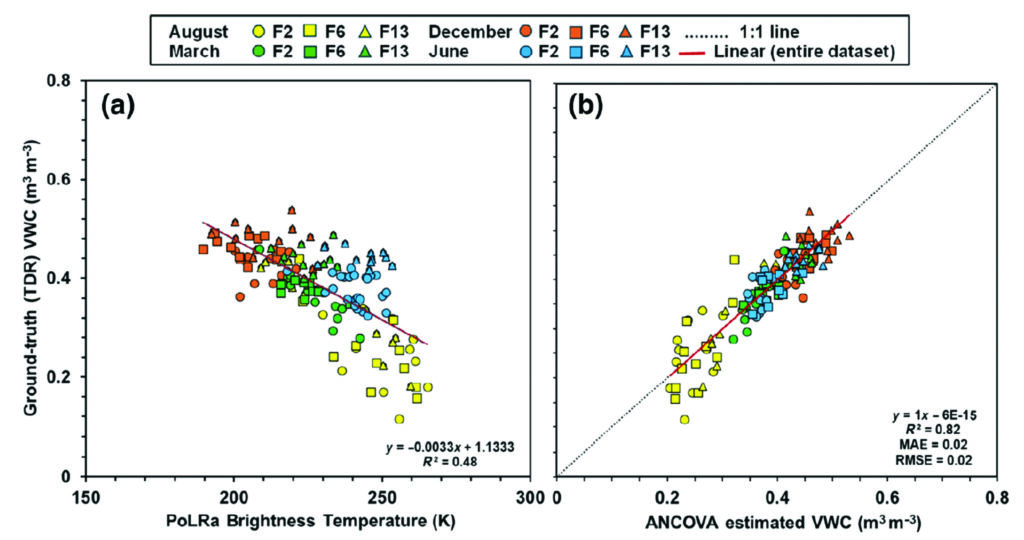
The results showed a statistically significant relationship between turfRad readings and actual soil moisture, but accuracy was limited. The coefficient of determination (R²) was 0.36, indicating that the sensor explained only about one-third of the variability measured by the TDR probes (Figure 2). Prediction errors were relatively large, with volumetric water content (VWC) average errors of 8-9 percent (0.08–0.09 m³ m–³).
In practice, this level of accuracy is insufficient for precision irrigation. While the maps might reveal broad wet and dry zones, they could easily misrepresent actual soil moisture levels, especially during stressful conditions like midsummer heat. The takeaway is clear: turfRad should not be treated as a factory-calibrated, universal sensor.
Site-specific calibration changes everything
The most important finding of the study emerged when researchers applied a site-specific calibration approach using the statistical method Analysis of Covariance (ANCOVA).
Without diving into the math, ANCOVA allows the sensor’s signal to be adjusted based on local conditions, accounting for differences among fairways and sampling dates, while still using a single overall relationship between microwave emissions and soil moisture (Figure 3).
With this calibration in place, performance improved dramatically:
- R² increased to 0.82
- Average error dropped to 2 percent volumetric water content (VWC) (0.02 m³ m–³)
- Prediction accuracy improved by nearly 80 percent
At this level, turfRad moved from a research curiosity to a genuinely useful irrigation tool.
For perspective, these error levels are considered “very good” even in agricultural remote sensing studies. They are more than adequate for identifying irrigation needs, prioritizing hand-watering and refining variable-rate irrigation strategies.
What this means for superintendents
The results point to a clear message: turfRad can accurately map soil moisture across fairways, but calibration is not optional.
This mirrors what superintendents already know from experience. Soil moisture sensors, whether hand-held, in-ground or mobile, are influenced by soil type, salinity, organic matter, turf species, thatch and management practices. A single calibration curve rarely works everywhere.
The encouraging news is that the calibration process used in this study required relatively few ground-truth measurements. Previous research suggests that as few as three to five calibration points per area may be sufficient. That means calibration could realistically be done by a superintendent or consultant without excessive labor.
Once calibrated, the sensor can generate detailed moisture maps quickly, allowing superintendents to:
- Identify chronic wet or dry areas
- Adjust irrigation runtimes by zone
- Fine-tune hand-watering priorities
- Monitor seasonal changes in soil moisture
- Evaluate irrigation system performance
Where turfRad really shines
One of turfRad’s biggest advantages is speed. Because it collects data continuously while driving, a superintendent could map an entire fairway in minutes rather than hours. This opens the door to frequent mapping, not just occasional spot checks.
Repeated maps could help answer questions superintendents regularly ask:
- Are certain areas consistently overwatered?
- How does soil moisture change after aerification?
- Are wetting agents improving uniformity?
- How does moisture distribution shift during drought restrictions?
In this way, turfRad complements existing sensors rather than replacing them. Handheld TDR probes still provide depth-specific readings. In-ground sensors still offer continuous monitoring. So, turfRad adds spatial context showing how conditions vary across the entire playing surface.
Limitations and cautions
Despite the promising results, there are limitations. First, calibration appears to be site-specific. What works on one course, or even one fairway, may not transfer directly to another. Differences in soil texture, turf species, mowing height and management practices all influence microwave emissions.
Second, our study focused on a single golf course. While the results are strong, broader testing across different climates, grasses and soil types is still needed.
Finally, turfRad measures soil moisture primarily in the upper soil profile. While this is highly relevant for fairway turf, it does not replace deeper root-zone measurements in all situations. In short, turfRad is not a silver bullet, but it is a powerful addition to the toolbox.
The bigger picture
One of the most important lessons from this research is that technology alone does not deliver precision irrigation. Sensors, maps and models only become valuable when integrated into a thoughtful management system.
The real value of turfRad lies in its ability to inform decisions, not make them automatically. Superintendents still need to interpret the data, understand unique conditions on their course and balance playability, turf health and water conservation.
Used correctly, however, turfRad could help move irrigation management from reactive to proactive, from “watering just in case” to “watering with confidence.”
Bottom line
Portable L-band radiometry represents one of the most promising advances in golf course irrigation management in years. Our study demonstrates that turfRad can accurately map fairway soil moisture at operational speeds, but only when properly calibrated to local conditions.
For superintendents willing to invest time in calibration and interpretation, the technology offers a new level of insight into soil moisture variability. In an era of tightening water budgets and increasing scrutiny, that insight could prove invaluable.
The future of irrigation is not just about applying less water; it is about applying water smarter, and turfRad may help make that a reality.
For more information, contact Madan Sapkota, Ph.D., Texas A&M University, madan.sapkota@tamu.edu
Source: Sapkota, M., Straw, C. M., Floyd, W. W., & Scudiero, E. (2025). Portable L-band radiometry for soil moisture mapping on golf course fairways: A calibration study with analysis of covariance regression in Texas. International Turfgrass Society Research Journal. doi.org/10.1002/its2.70018
This research was funded by the USGA Mike Davis Program and the South Texas Golf Course Superintendents Association.
Subscribe to Golfdom



If you enjoyed this article, subscribe to Golfdom to receive more articles just like it.