




3 USGA projects on plant growth regulators
Interseeding methods for conversion of golf fairways to dollar spot-resistant bentgrass
Research Takeaways
- Interseeding resistant bentgrass cultivars reduced dollar spot severity by up to 42 percent, with disease suppression increasing as the percentage of resistant plants increased.
- Glyphosate-assisted interseeding produced the best results in Wisconsin, reducing dollar spot and fungicide applications while improving establishment of resistant cultivars.
- Higher pH and increased calcium improved annual bluegrass quality but reduced bentgrass encroachment, while acidic conditions favored creeping bentgrass establishment.
- Phosphorus and paclobutrazol produced little measurable effect during the first year, suggesting longer-term evaluation is needed before management recommendations can be made.
- Bermudagrass and zoysiagrass maintained acceptable quality under up to 40 percent shade, but turf performance declined sharply under 50 percent shade.
- Trinexapac-ethyl (Primo Maxx) consistently improved turf quality under shaded conditions, with future research evaluating whether it also enhances winter survival and cold tolerance.

This USGA-funded research project, led by Purdue University in collaboration with the University of Wisconsin and the USDA-ARS, is investigating whether golf course fairways can be converted to new dollar spot-resistant creeping bentgrass cultivars through interseeding rather than complete renovation. The objective is to reduce fungicide use and maintenance costs while avoiding the expense and disruption associated with closing fairways for renovation.
Dollar spot remains the most expensive and fungicide-intensive disease on golf courses. Although fungicide applications are more frequent on putting greens, fairways occupy nearly nine times more acreage (28.1 acres versus 3.2 acres), making even a single eliminated fungicide application a significant economic benefit.
Greenhouse experiments
Modern bentgrass cultivars with improved dollar spot resistance are available, but their widespread adoption has been limited due to renovation costs and uncertainty about long-term performance. Interseeding offers a potentially less-disruptive alternative. The project includes both greenhouse and field experiments.
Greenhouse studies evaluated blends of three resistant cultivars (Pure Select, 007 XL and Coho) mixed with the susceptible cultivar Penncross at ratios ranging from 0 to 100 percent resistant turf. Plants were inoculated with two isolates of Clarireedia jacksonii, including one fungicide-resistant strain.
The greenhouse results demonstrated a clear relationship between the composition of resistant cultivars and disease suppression. Penncross exhibited the greatest dollar spot severity, while all three resistant cultivars performed similarly and significantly better. Blends containing 90 to 100 percent resistant cultivars reduced disease severity by up to 42 percent, although no mixture conferred complete resistance. Disease declined progressively as the proportion of resistant plants increased, suggesting that higher interseeding rates will produce greater long-term benefits (Figure 1A).
Interseeding field trials
Three field trials were established in Indiana, Wisconsin and Pennsylvania using existing bentgrass fairways containing 10 to 30 percent annual bluegrass (Poa annua). The three resistant cultivars were interseeded with a slit seeder and compared across several establishment programs, including no herbicide, glyphosate renovation, and selective herbicide or plant growth regulator (PGR) programs using methiozolin, bispyribac-sodium, paclobutrazol, and amicarbazone.
Disease severity, turf quality, fungicide requirements and annual bluegrass populations were monitored throughout the growing season. Leaf clippings were also collected for genetic analysis to quantify the successful incorporation of the new cultivars into the existing turf stand.
Results varied by location (Table 2). In Wisconsin, glyphosate-treated plots consistently outperformed direct interseeding without herbicides, exhibiting 198 percent lower dollar spot severity in 2024 and 58 percent lower severity in 2025 (Figure 2A), while requiring the fewest fungicide applications (Figure 2B). Overall disease pressure also declined in 2025, suggesting the successful establishment of resistant cultivars.
In Indiana, disease differences between glyphosate and untreated interseeded plots were relatively small (9 to 12 percent), with similar fungicide requirements. Pennsylvania experienced little dollar spot pressure and no treatment differences.
Weed management responses also differed among locations. Methiozolin, paclobutrazol, and bispyribac-sodium reduced Poa annua populations more effectively than glyphosate in Indiana during 2024, although annual bluegrass increased across all treatments in 2025 (Figure 2C).
The final year of the project will integrate disease data, fungicide use, genetic analyses and Poa annua populations to determine the return on investment of complete renovation versus minimally disruptive interseeding strategies. The research has the potential to provide golf course superintendents with a practical pathway to gradually convert fairways to disease-resistant bentgrass cultivars while reducing fungicide inputs and long-term maintenance costs.
Source
Miller, Gerald (Lee); Ghimire, Krishna; Koch, Paul; Warnke, Scott; Ruwona, Justice. 2025. Evaluation of interseeding methods for conversion of golf fairways to bentgrass cultivars with enhanced dollar spot resistance. USGA Davis Research Summaries.
| Herbicide/PGR | Trade name | Timing* | Rate |
|---|---|---|---|
| Amicarbazone | Xonerate | 21 & 7 DBS | 3 fl oz/A |
| Bispyribac sodium | Velocity | 14 DBS 30 DAS |
1.5 fl oz/A 0.75 fl oz/A |
| Methiozolin | Poacure PM | 45 DBS & 84 DAS | 1.2 fl oz/1000 sq |
| Paclobutrazol | Trimmit | 14 DBS & 42 DAS | 16 oz/A |
| Glyphosate | Roundup Pro | 14 & 7 DBS | 48 oz/A |
| Untreated | Xonerate |
*DAS = Days After Seeding; DBS = Days Before Seeding
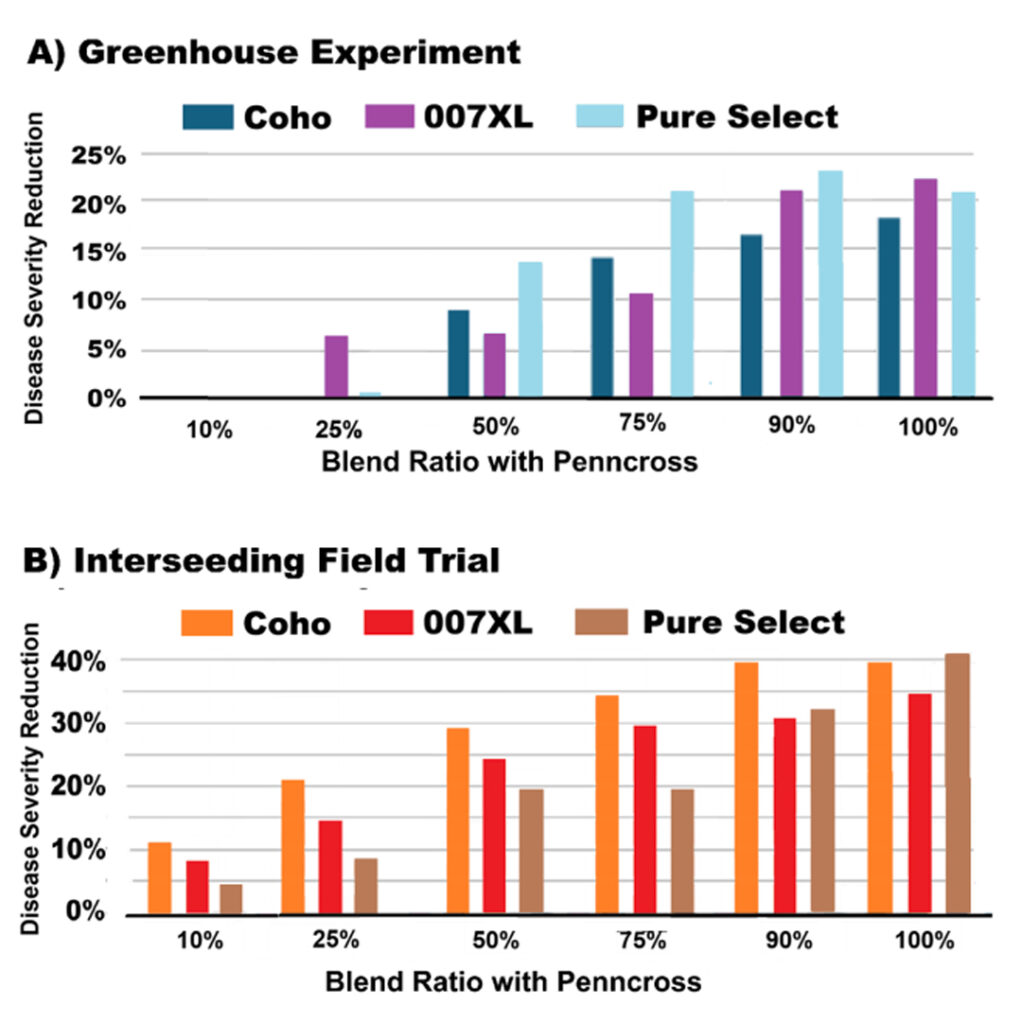
Figure 1.Disease severity reduction (A) Greenhouse Experiment and (B) Interseeding Field Trial based on the area under the disease progress curve (AUDPC). Reduction represents the percentage decrease in resistant cultivar polystand compared to Penncross monostand. AUDPC represents the total disease severity calculated over a given time.
| Factor | West Lafayette, Ind. | Madison, Wis. | |||
|---|---|---|---|---|---|
| Df | 2024² | 2025 | 2024 | 2025 | |
| Cultivar | 2 | 0.024³ | 0.071 | 0.005 | 0.279 |
| Herbicide/PGR | 5 | 0.144 | 0.885 | <0.0001 | 0.017 |
| Cult x Herb/PGR | 10 | 0.067 | 0.197 | 0.001 | 0.415 |
1 AUDPC (Area Under Disease Progress Curve) represents the total disease severity calculated over the assessment period with the trapezoidal rule.
2 Location and Year significantly influenced AUDPC (P < 0.001), necessitating separate analyses for each location.
3 Significant main effects or interactions (P < 0.05)
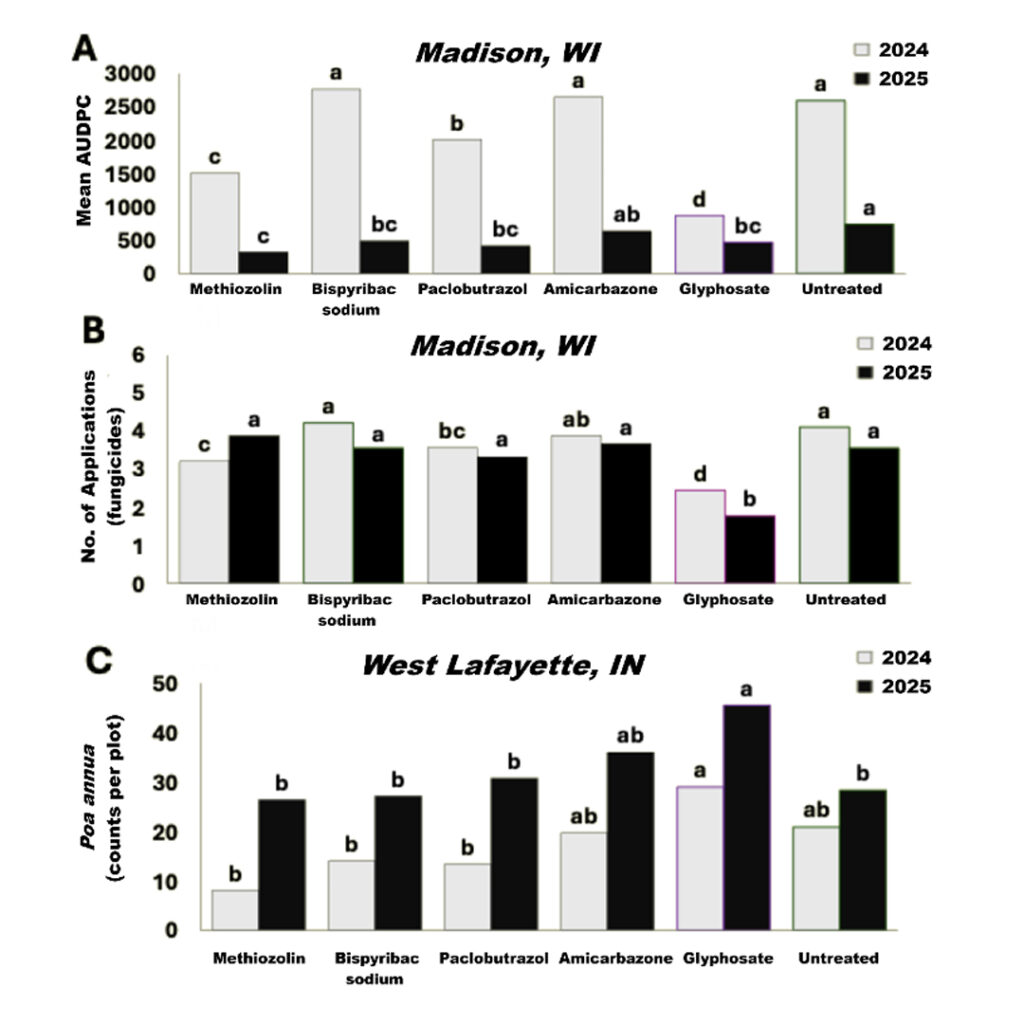
Figure 2. Herbicide/PGR effectiveness based on (A) the area under the disease curve progress curve (AUDPC) based on dollar spot severity, (B) number of fungicide applications during the 2024 and 2025 seasons in Wisconsin, and (C) Poa counts conducted during Poa annua seedhead flush (GDD22) on April 19, 2024, and April 26, 2025. Columns with the same letter are not significantly different according to Fisher’s Protected LSD (P = 0.05).
Integrating phosphorus and pH management with a PGR for annual bluegrass suppression in bentgrass
This three-year Rutgers University study is investigating how mat layer pH, phosphorus availability, and paclobutrazol applications interact to influence competition between creeping bentgrass and annual bluegrass on putting greens. The research aims to provide superintendents with practical strategies to either encourage bentgrass encroachment or maintain annual bluegrass dominance by manipulating soil chemistry and regulating plant growth.
The central hypothesis is that a strongly acidic mat layer (approximately pH 5.5) combined with relatively low phosphorus levels (6 to 10 ppm) and paclobutrazol applications will favor creeping bentgrass over annual bluegrass. Two field experiments were established in 2025. Project 1 examines acidic versus neutral pH, low versus adequate phosphorus, and paclobutrazol versus trinexapac-ethyl treatments using the creeping bentgrass cultivar Oakley. Project 2 evaluates the encroachment of Penncross and Oakley bentgrass into annual bluegrass across a pH gradient ranging from 4.8 to 7.0. Creeping bentgrass plugs were installed during late June and early July 2025, with encroachment first measured in November.
Project 1: pH, phosphorus, and PGR effects
The pH treatments successfully established distinctly different rootzone conditions, with averages of pH 5.2 in acidic plots and pH 6.7 in neutral plots. Turf quality was consistently affected by pH throughout the season, with plots at neutral pH maintaining superior quality ratings. In contrast, phosphorus treatments and paclobutrazol applications had no significant effect on turf quality or bentgrass cover during the first year.
An unexpected finding was that mat layer phosphorus concentrations increased naturally from 47 ppm in November 2024 to 53 ppm in June 2025, despite no phosphorus applications since 2023 (data not shown). This unexpected accumulation of phosphorus may complicate attempts to create the low-phosphorus conditions needed to test the original hypothesis.
Although no statistically significant differences in bentgrass encroachment were detected, researchers observed a non-significant trend toward greater bentgrass cover in acidic, low-phosphorus plots and expect clearer treatment differences as the experiment matures.
Project 2: Effects of pH and calcium
Project 2 produced stronger responses. Mat layer pH ranged from 5.2 in untreated plots to 7.0 in the highest lime treatments, with calcium concentrations increasing proportionally as lime rates increased (Table 3). Turf quality improved dramatically as pH increased, particularly during the summer stress period. The highest lime rates consistently produced quality ratings above 7.0, whereas acidic plots often fell below acceptable levels for putting green quality. Gypsum and gypsum plus supplemental nitrogen partially improved turf quality compared with untreated acidic plots but did not equal the performance of the highest lime treatments.
Perhaps the most important finding was that bentgrass encroachment decreased with increasing lime rates (Table 4). The three highest lime treatments produced only 72 to 78 percent of the bentgrass cover observed in untreated plots, indicating that higher pH suppresses bentgrass expansion into annual bluegrass. Gypsum also reduced bentgrass encroachment despite maintaining acidic pH, suggesting that calcium availability, not simply pH, is a key factor enhancing annual bluegrass competitiveness.
Practical implications
These first-year results suggest that near-neutral pH and elevated calcium improve annual bluegrass quality and competitiveness, while more acidic conditions favor bentgrass encroachment. The effects of phosphorus and paclobutrazol have not yet emerged, likely due to unexpectedly high background phosphorus levels and the early stage of bentgrass establishment. During 2026, researchers will establish a second experimental run, continue measuring bentgrass expansion, analyze tissue nutrient concentrations, and further investigate rootzone phosphorus dynamics to refine recommendations for managing bentgrass–annual bluegrass populations on putting greens.
Source
Elmore, Matthew T.; Murphy, James A.; Nwachukwu, Emmanuel. 2025. Integrating phosphorus and pH management with a plant growth regulator for annual bluegrass suppression in bentgrass. USGA Davis Research Summaries.
Table 3. Mat layer pH and calcium, turfgrass quality and NDVI and NDRE for selected dates, and bentgrass cover as affected by amendments for Project 2. Turfgrass quality values >7.0 are shaded in green and those <6.0 are shaded in red.
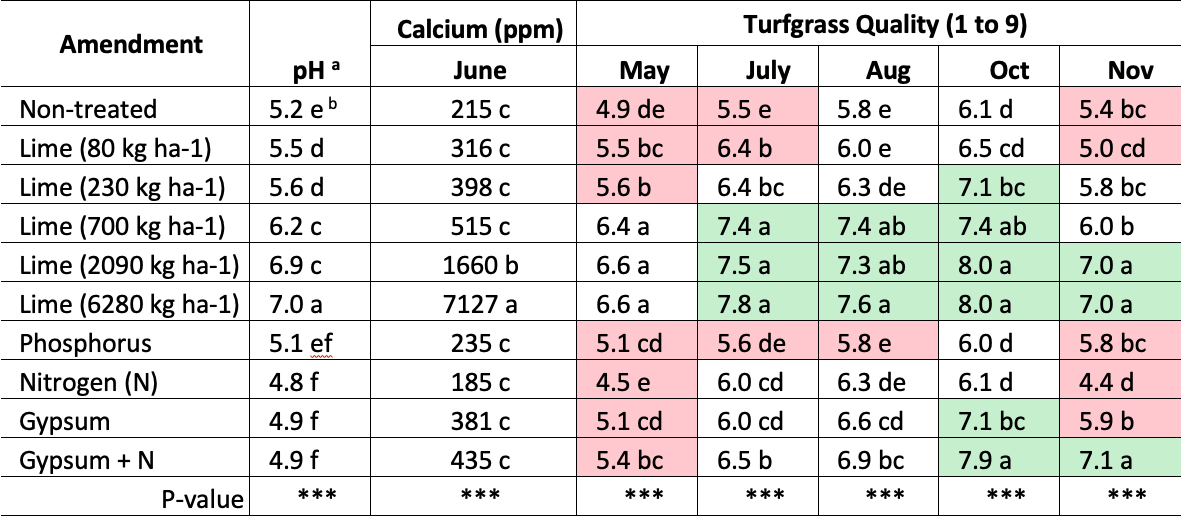
Abbreviations: *, ***, NS; P-value < 0.05, 0.001, and not significant, respectively.
a pH and Mehlich III calcium of mat layer sampled in June 2025.
b Means followed by the same letter are not significantly different (Fisher’s Protected LSD0.05 test).
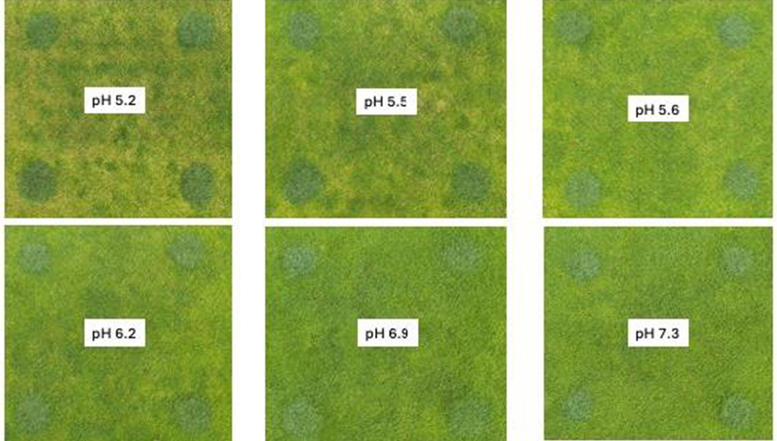
Figure 3. Plot differences on 24 September 2025 as affected by mat layer pH in Project 2. Notice the difference in annual bluegrass color as affected by pH, while the four bentgrass plugs appear unaffected.
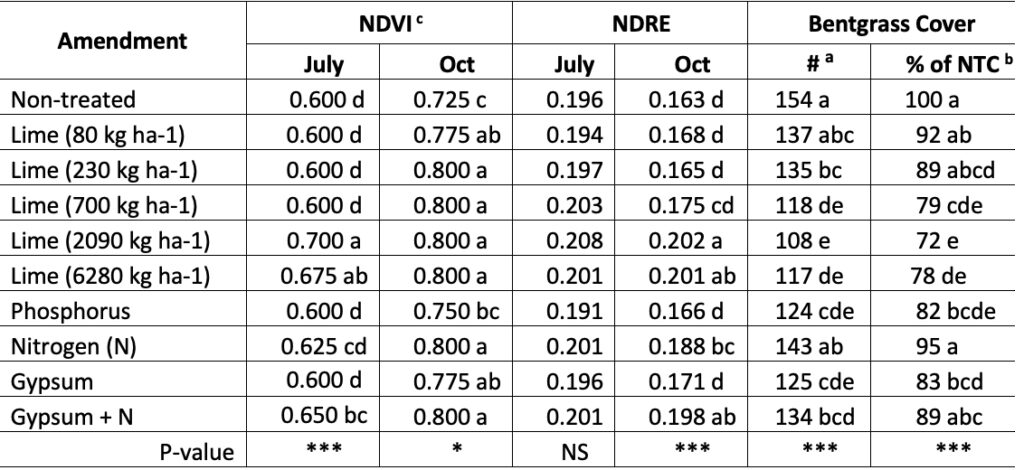
Abbreviations: *, ***, NS; P-value < 0.05, 0.001, and not significant, respectively.
a Number of intersects determined to be creeping bentgrass pooled across cultivars. A greater number of intersections indicates greater cover.
b Bentgrass cover compared to the non-treated control, pooled across cultivars.
c Means followed by the same letter are not significantly different (Fisher’s Protected LSD0.05 test).
| Amendment | NDVIc | NDRE | Bentgrass Cover | |||
|---|---|---|---|---|---|---|
| July | Oct. | July | Oct. | #a | % of NTCb | |
| Non-treated | 0.600 d | 0.725 c | 0.196 | 0.163 d | 154 a | 100 a |
| Lime (80 kg ha-1) | 0.600 d | 0.775 ab | 0.194 | 0.168 d | 137 abc | 92 ab |
| Lime (230 kg ha-1) | 0.600 d | 0.800 a | 0.197 | 0.165 d | 135 bc | 89 abcd |
| Lime (700 kg ha-1) | 0.600 d | 0.800 a | 0.203 | 0.175 cd | 118 de | 79 cde |
| Lime (2090 kg ha-1) | 0.700 a | 0.800 a | 0.208 | 0.202 a | 108 e | 72 e |
| Lime (6280 kg ha-1) | 0.675 ab | 0.800 a | 0.201 | 0.201 ab | 117 de | 78 de |
| Phosphorus | 0.600 d | 0.750 bc | 0.191 | 0.166 d | 124 cde | 82 bcde |
| Nitrogen (N) | 0.625 cd | 0.800 a | 0.201 | 0.188 bc | 143 ab | 95 a |
| Gypsum | 0.600 d | 0.775 ab | 0.196 | 0.171 d | 125 cde | 83 bcd |
| Gypsum + N | 0.650 bc | 0.800 a | 0.201 | 0.198 ab | 134 bcd | 89 abc |
| P-value | *** | * | NS | *** | *** | *** |
Abbreviations: *, ***, NS; P-value < 0.05, 0.001, and not significant, respectively.
a Number of intersects determined to be creeping bentgrass pooled across cultivars. A greater number of intersections indicates greater cover.
b Bentgrass cover compared to the non-treated control, pooled across cultivars.
c Means followed by the same letter are not significantly different (Fisher’s Protected LSD0.05 test).
Effects of shade on cold tolerance and winter injury of warm-season grasses
This University of Arkansas research project investigates how shade and the plant growth regulator (PGR) trinexapac-ethyl influence cold tolerance, carbohydrate storage, and winter survival in warm-season golf course turfgrasses. The study focuses on ultradwarf bermudagrass putting greens and zoysiagrass fairways, two turf species that are increasingly used throughout the transition zone but remain vulnerable to winter injury, particularly in shaded environments. The project runs from 2025 through spring 2027, with the most important cold-tolerance data scheduled for collection in 2026.
The research addresses a common observation among golf course superintendents: shaded areas frequently experience greater winterkill than turf exposed to full sunlight. Although this relationship has been widely discussed in extension literature and management guides, little research has quantified how much shade is required to increase winter injury or whether plant growth regulators can mitigate those effects.
Two field trials were established at the Milo J. Shult Agricultural Research & Extension Center in Fayetteville, Ark. One trial uses Tif3D ultradwarf bermudagrass maintained at a 0.125-inch putting green height, while the second evaluates Cavalier zoysiagrass maintained at a 0.5-inch fairway height. Shade structures were installed from May through October to provide five light environments: 0, 20, 30, 40 and 50 percent shade, producing daily light integrals ranging from approximately 22 to 44 mol m⁻² day⁻¹. Half of the plots received trinexapac-ethyl (Primo Maxx) applications at label rates, while the remaining plots served as untreated controls.
Throughout the 2025 growing season, researchers evaluated turf quality, digital green cover, and color while continuously monitoring light levels and soil temperatures. Statistical analysis demonstrated that shade, PGR application, and time significantly influenced turfgrass quality for both species. Shade intensity had the largest effect, with turf quality declining progressively as shade increased. However, both bermudagrass and zoysiagrass maintained acceptable quality and coverage under 0 to 40 percent shade, with noticeable deterioration occurring only under 50 percent shade.
Application of trinexapac-ethyl produced small but consistent improvements in turf quality under shaded conditions for both species. The PGR did not eliminate the negative effects of shade but appeared to help maintain turf performance as light availability declined. Researchers consider this encouraging because one objective is to identify shade levels that have little effect on summer turf quality but may still predispose turf to winter injury. The severe decline in quality observed under 50 percent shade confirms that the experiment is imposing sufficient stress to detect biologically meaningful differences. The most significant phase of the project will occur in early 2026. Intact turf plugs will be collected from each shade × PGR treatment and subjected to controlled freeze-chamber testing. Temperatures will gradually decline from 2 degrees Celsius to as low as 11 degrees below zero Celsius, allowing researchers to estimate LT50 values—the temperature at which 50 percent of the turf is killed. Additional samples will be analyzed for stem carbohydrate concentrations, providing insight into whether reduced light limits carbohydrate reserves needed for winter survival. Field plots will also be evaluated for actual winterkill during spring 2026.
If successful, this research will establish quantitative shade thresholds associated with increased winter injury and determine whether trinexapac-ethyl can improve cold tolerance through enhanced carbohydrate storage. The findings could provide golf course superintendents with science-based recommendations for managing shaded ultradwarf bermudagrass greens and zoysiagrass fairways in the transition zone while reducing the risk of costly winter damage.
Source
Richardson, Michael; Hutchens, Wendell; McCalla, John; Green, Will. 2025. Effects of shade on cold tolerance and winter injury of warm-season grasses. USGA Davis Research Summaries.
| 0% shade | 20% shade | 30% shade | 40% shade | 50% shade |
|---|---|---|---|---|
| PGR + | PGR – | PGR – | PGR + | PGR – |
| PGR – | PGR + | PGR + | PGR – | PGR + |
Table 6. Summary analysis of variance for turfgrass quality using a repeated measures analysis, testing the whole plot (shade) and split plot (PGR) factors and date and their interactions. Cells that are shaded with green are significant at the P<0.05 level.
| Tif3D bermudagrass | Cavalier zoysiagrass | ||||
|---|---|---|---|---|---|
| Effect | DF | F Value | Pr > F | F Value | Pr > F |
| Shade | 4 | 117.29 | <0.0001 | 51.37 | <0.0001 |
| PGR | 1 | 12.22 | 0.0006 | 23.37 | <0.0001 |
| Date | 4 | 6.18 | 0.0001 | 3.35 | 0.0113 |
| Shade * Date | 16 | 2.53 | 0.0016 | 2.20 | 0.0067 |
| Shade * PGR | 4 | 1.56 | 0.1867 | 0.42 | 0.7972 |
| PGR * Date | 4 | 1.46 | 0.2162 | 6.61 | <0.0001 |
| Shade * PGR * Date | 16 | 0.55 | 0.9179 | 0.89 | 0.5863 |
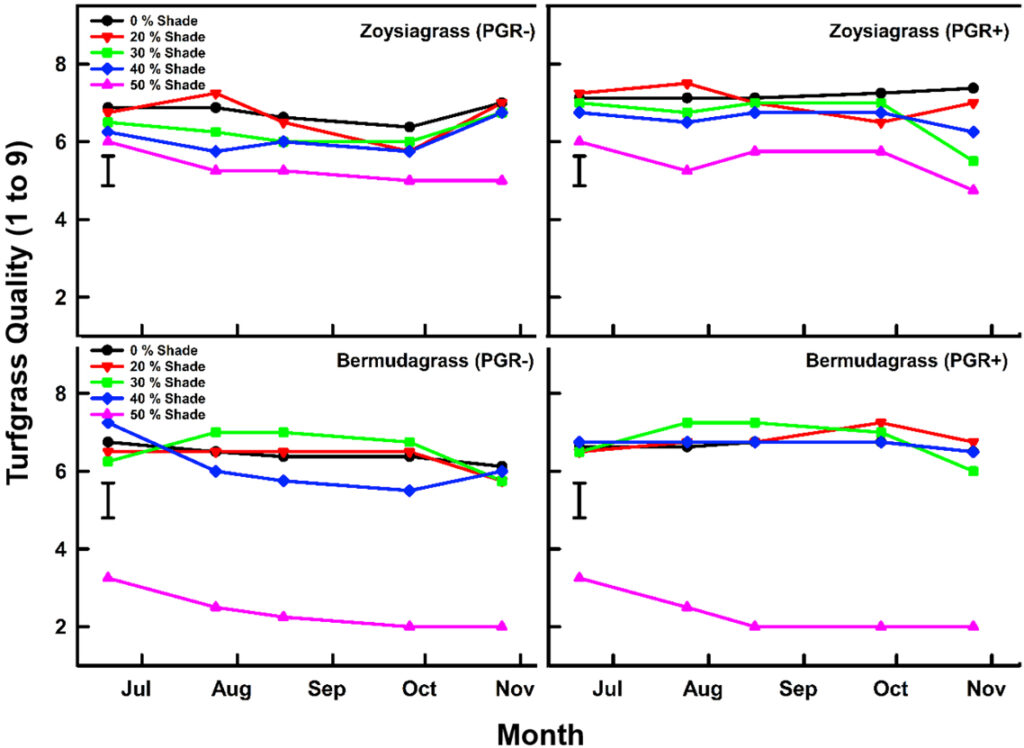
Figure 4. Turfgrass quality of ‘Tif3D’ bermudagrass (HOC = 0.125 inch) and ‘Cavalier’ zoysiagrass (HOC = 0.5 inch) over the 2025 season in Fayetteville AR, as affected by shade levels and application of the plant growth regulator (PRG), trinexapac-ethyl. Error bars represent the least significant difference (P<0.05) values for comparing treatments and dates within each species.
Subscribe to Golfdom



If you enjoyed this article, subscribe to Golfdom to receive more articles just like it.