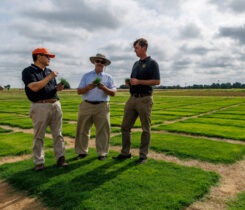





Inside Wigwam Gold Course: How smart agronomy keeps Arizona’s Monster thriving

In 1965, Robert Trent Jones Sr. designed Wigwam Golf Club’s Gold Course, a parkland-style, 18-hole championship course that has since stood out among the Phoenix area’s typical desert courses.
Measuring 7,345 yards from the back tees, the course has consistently been a challenge for golfers of all skill levels, including USGA qualifiers and NCAA golfers that regularly compete here. Likewise, it has steadily been viewed as a “refreshing change” from other desert golf courses, according to Director of Agronomy Oscar Magallon.
After all, it provides golfers “a traditional, walkable experience” that contrasts with other courses nearby. Known as “Arizona’s Monster,” mainly due to its length, the Gold Course even has tree-lined fairways and lush grass. Simply put, it’s unlike nearly any other course in the Grand Canyon State.
“It reflects traditional design principles by incorporating wide playing corridors, strategic hazard placement and contoured greens that force players to execute a variety of shots,” Magallon says. “Our maintenance and irrigation teams respond to this by promoting firm, fast playing conditions that enhance these strategic elements.”
Magallon and his maintenance and irrigation teams implement numerous practices, while operating as one core unit under his management. For irrigation purposes, staff members use POGO moisture sensors. The sensors have positively influenced Magallon’s primary day-to-day goal: to preserve the Gold Course’s optimal playing standards.
The sensors offer Magallon and his teams daily moisture readings, which they then utilize to provide consistent playing conditions. Through these readings, maintenance and irrigation team members have been able to understand the Gold Course’s water needs more than ever.
Innovative maintenance methods
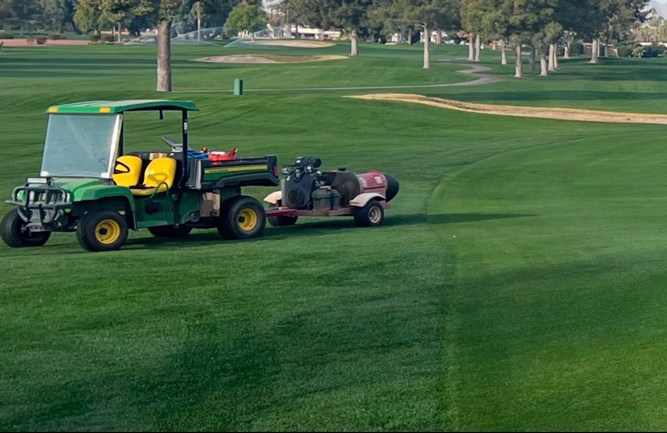
Along with using POGO sensors, Magallon and his teams have also implemented other innovative techniques, resulting in further course enhancements. They’ve especially invested heavily in a wetting agent known as Resgenix. Applied through the Gold Course’s irrigation system, the wetting agent ensures that turf will absorb more water on a steady basis.
“I can simply set Resgenix and forget about it,” he says. “Every time we water, it is automatically applied.”
Moreover, during the summer months, Magallon’s team members mow the Gold Course during the middle of the day, rather than in the early morning. Why? Well, there are several reasons.
First, golfers can start their rounds earlier in the day, allowing them to finish playing 18 holes before temperatures get too high. Second, team members are protected from the highest temperatures of any given day as they’re conducting their manual labor in the morning.
“Finally, in the heat of the day, the staff is on mowers instead of doing manual labor,” Magallon adds.
Prioritizing soil health
Magallon and his teams are also committed to enhancing the Gold Course’s soil health in any way they can. Primarily, they use a granular fertilizer known as DCM 18-0-7. The fertilizer is applied to the course twice a year. Each time, roughly 150 pounds is applied per acre. In November, an application generally occurs for post-overseed purposes. Six months later, a second application is provided during the course’s transition period.
On a yearly basis, the Gold Course also closes for a few days in the summer to topdress greens. Throughout this process, 30-40 tons of USGA premium sand are applied on each acre once the course’s aerification has been completed.
“For efficient application, we use the Dakota Turf Tender,” Magallon says. “And we perform light topdressing on the greens to maintain their firmness. This is critical during the hotter months when we increase our watering to combat the heat.”
Through each of these practices, Magallon believes he and his teams have created a “robust and vibrant course.” Four types of mowers — two red, two green — are used at Wigwam. For the rough, Magallon and his teams utilize the Toro 5900 and the Toro 4700. For fairways and greens, they use John Deere’s JD 8900 and the JD 2750 Triplex, respectively.
Additionally, in 2022, Magallon worked with his team members to enhance the Gold Course’s irrigation system. Every sprinkler head was inspected to ensure its nozzle and arc worked properly. All data was recorded in a Lynx irrigation system, leading to a more consistent output.
“We successfully eliminated previous existing wet areas and significantly improved the drier areas, creating a better product,” he explains.

Optimal conditions
To further improve the Gold Course’s conditioning, Magallon and his teams always utilize the Toro ProCore 648 during the aerification process. Each year, the aerator has a 0.625-inch tine that pulls cores from greens. Plugs are collected, and then those 30-40 tons of USGA premium sand are applied per acre.
“We roll the greens with a Salsco roller and complete the process by applying DCM 2-1-2 Micro-Mix fertilizer at a rate of 200 pounds an acre, providing the necessary nutrients for healthy growth,” Magallon says.
During the spring, as part of the teams’ maintenance routines, they also apply an insecticide known as Triple Crown. This treatment keeps the Gold Course ant-free year after year. At the same time, they use Dimension, a preemergent herbicide, every spring. Through Dimension, Magallon and his team have successfully combatted crabgrass and goosegrass growth in the summer months.
“If we experience any breakthrough of these weeds, we’ll promptly address the situation with spot treatments using Revolver,” Magallon says.
Of equal importance, Magallon’s teams hand-rake every bunker daily, guaranteeing they’re in peak condition prior to the beginning of each day’s rounds. Once or twice a month, the bunkers’ faces are also mowed and edged. Finally, the teams utilize one more type of technology for the bunkers, which were restored by Lehman Design Group in 2015.
“In the summer, we use Toro’s Sand Pro to loosen compacted sand, particularly given the high volume of water we apply,” he says. “This helps maintain the bunkers’ quality and playability.”
Preparing for the next 10 years
As a result of Arizona’s present-day significant water restrictions, Magallon and his teams have created a 10-year plan. To minimize water loss due to seepage — and ensure the Gold Course has more efficient water management — the project will line every pond on the property.
“We’ll gradually transition to using robotic mowers, too,” Magallon notes. “By embracing this technology, we’ll enhance our efficiency in maintaining the property.”
Finally, Magallon plans on steadily using organic fertilizers, just as he has since 2022. Concurrently, he’ll avoid any usage of high-salt alternatives, as they may negatively influence the Gold Course’s soil health.
“This approach has allowed me to enhance the soil environment, fostering healthy turf growth,” he concludes. “I’m committed to continuing the usage of DCM products, as they’ve played a major role in improving the Gold Course’s soil quality.”
Chris Lewis, owner of Innovative Written Solutions, has written about numerous topics, including equipment, golf courses, professional golfers and technology innovations, for more than 25 golf publications and websites.
Subscribe to Golfdom



If you enjoyed this article, subscribe to Golfdom to receive more articles just like it.