





How two clubs solved cart path headaches and bunker nightmares
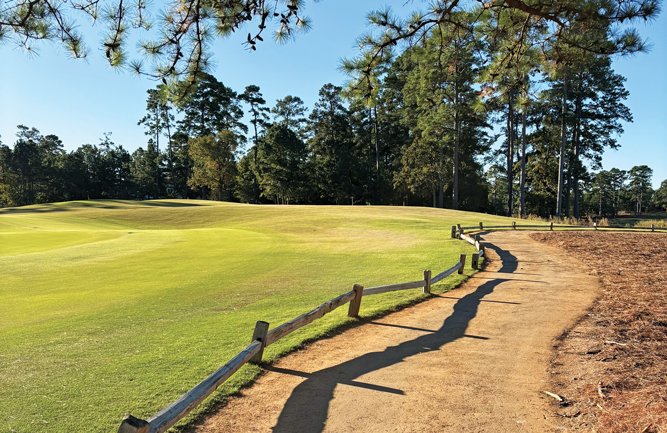
Bluejack National, Montgomery, Texas
Celebrating its 10-year anniversary just last month, Bluejack National is famous for being the first — and only private — Tiger Woods-designed golf course in America. Eric Bauer, director of agronomy, has been the only superintendent of the course, joining the club while it was still under construction. Prior to joining Bluejack, he was the director of grounds at The Club at Carlton Woods in The Woodlands, Texas, for almost 14 years.
With a long career in Houston, Bauer knows all too well the weather challenges the area faces. Heat and humidity in the summer months, sure, but the area also can get socked with rain — to the tune of 60 inches a season.
When Woods and the developer built the course, they didn’t install traditional cart paths. There were paths, but they could be better described as maintenance service roads — for moving equipment in and out when the course was wet.
“We struggled our first few years. Whenever we got rain, we had to make a decision … do we let carts out or not?” Bauer says. “If we got a little bit of bad weather, we’d tell members, ‘The only way you can play is if you walk.’ You know what the member said? ‘Yeah, I’ll wait for it to be nice, I’m not going to come out.’ That’s not good. Even at a private club, you still want to have activity, you want to have members use the club and bring guests out.”
Two holes were particularly taxing on the decision to allow carts. Neither hole had cart paths.
“If one of those holes is wet, I’d have to pull carts,” Bauer says. “Everything we did, it depended on one hole and whether I could get a cart to drive down the side, in the native area. It wasn’t even heavily sloped. But if I couldn’t, there was nothing left to do.”
Wanting to keep the course looking natural, Bauer installed a decomposed granite on those holes. It would crumble and create more work for his crew.
“I was working with different people, trying different things … nothing really seemed to work,” he says. “For me, it was frustrating because we really wanted a natural material, because anything else would take away from the (course’s) beauty.”
A new natural material
It was a few years ago at a GCSAA Conference and Trade Show that Bauer first came across Kafka Granite. The Wisconsin-based company (and regular Golfdom Summit partner) is one of the leading granite manufacturers in America and services a wide clientele of commercial properties, parks, homeowners and golf courses.
Bauer liked the company’s easy entry offer: Pay the freight, and they’d send him a stack of material to try out.
“I was really interested in their process,” Bauer says. “We ended up testing it for about a year on a couple of my high-slope areas, and I was amazed at how well it did. We thought it would be a great addition to Bluejack National, and expanding our cart path experience for our members when we’re cart-path only.”
Bauer adds that prior to adding the Kafka paths to Bluejack, the course was walking-only roughly 30 to 40 percent of the time.
His favorite thing about the material is that once it’s installed, he can forget about it.
“When I tell you I’ve had zero maintenance to it, I mean it’s been zero maintenance, unlike a concrete path or an asphalt path,” he says. “I think we found our natural material. Superintendents, we’re all guilty of it — we all try to strive to find that perfect material. We hate cart paths, asphalt paths, whatever.
“But there’s just been nothing. Up until what I’ve just experienced, there hasn’t been anything that has been able to hold up to my specific elements and topography,” Bauer continues. “What we’re trying to do is find something that holds up, looks natural, is easy to install. And Kafka just checked all those boxes.”
No need to hide
While the functionality of the paths has been great, the aesthetics are especially pleasing to the members at Bluejack. He says the look of the paths is comparable to a country dirt road, which fits in with the look of the course.
Had they installed asphalt paths, it would have detracted from the beauty of the course, he says.
“We would have spent a lot more money trying to hide them, like these architects try to do,” he says. “How much time (do architects) spend trying to hide cart paths? And we spend so much money on building them … but then they hide them? There’s irony in that.”
Since the initial installation, the team at Bluejack has added Kafka Granite to more holes and several walking trails in the community. Bauer’s goal over the next three to four years is to get rid of all the decomposed granite paths and replace them with Kafka Granite.
The expectations of an exceptional experience for members at Bluejack, like at most elite golf clubs, are high. Bauer says in the past, when the membership satisfaction survey was distributed, one place he’d get dinged was on the cart path situation at Bluejack.
Now, with these recent changes, he’s excited to see how the membership satisfaction survey reads when it comes to cart paths.
“I was never giving up. The easy thing to do would have been to be like, ‘Let’s go back to asphalt or add concrete,’” Bauer says. “Finding something that was as good as what I’m seeing, we’ve made it a better experience.”
How’s it installed?
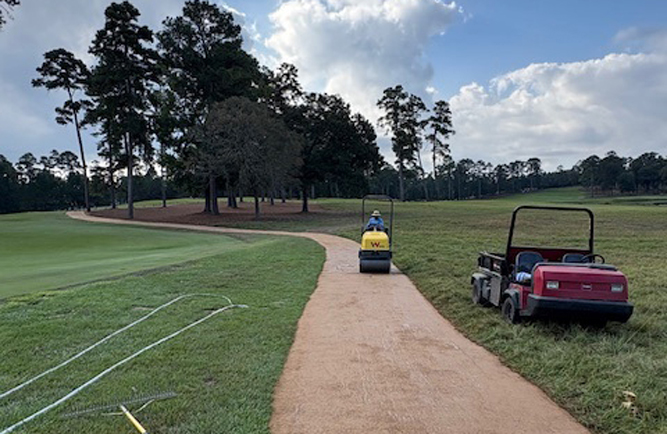
Bauer calls the installation of Kafka Granite “very simple,” and adds they did all the work in-house.
He suggests coring out about 6 inches deep to get a good base. Come back with four inches of a compacted road base material, similar to installing asphalt. He adds to choose a base that’s a little finer than bigger rocks, so it compacts well.
From there, he adds 3 inches of Kafka Granite and compacts it down to 2 inches using a roller.
“That’s it, man — then you walk away,” he says.
Cragun’s Legacy Courses, Brainerd, Minn.
Matt McKinnon has enjoyed a long career at Cragun’s Legacy Courses in central Minnesota. He started there as an assistant superintendent of what was then an 18-hole property, then was promoted to superintendent and then became director of golf course maintenance shortly after. He recently celebrated his 28-year anniversary at the property.

The course is in an area McKinnon calls “lake country — Minneapolis’ playground.” Construction started in 1997; the first 18 holes opened in September 1998, and then they kept building. By the time construction was complete, there were two 18-hole courses and a par-3 course.
Then, in 2020, Tom Lehman came to the course to see his son play in the Minnesota PGA Junior Match Play Championship and met the course’s then-owner, Dutch Cragun. Both are Minnesota Golden Gophers, and the two hit it off.
What ensued was a 36-hole remodel with the addition of a new nine-hole course. Every hole was touched, some with minimal changes, and some with massive changes.
That includes 155,000 square feet — well over 3 acres — of bunker renovations.
A wall-to-wall decision
In all of Minnesota, the freeze/thaw cycle has a major effect on the health of a golf course. At the Legacy, the course is built on sandy, but rocky, soil. Constantly, the effects of the freeze/thaw cycle would show itself in the course’s bunkers.
Even after McKinnon changed out the bunker sand a couple times in 20 years, rocks were prevalent, and golfers would complain.
“Remember the old Nolte Sand Cleaner? It came from Europe. We bought one,” McKinnon recalls. “We ran it in every bunker, and we pulled so many rocks out. You could do it in the same bunker five times and still pull out the same number of rocks. It was just never-ending.”
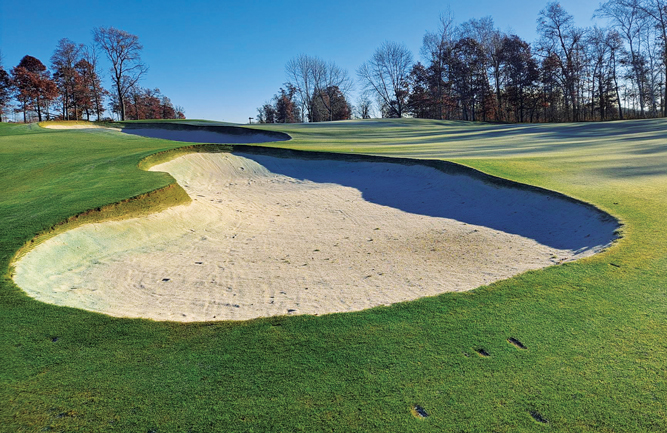
That was until 2020 when the discussion got serious about redoing the bunkers across the entire facility. In 2020, the decision was made to renovate all the bunkers using Sand Guard, a blend of stone aggregate, rubber chips and Sand Guard technology from Porous Pave (another Golfdom Summit partner) for a flexible liner for bunkers.
“When the owners started talking to the designer, everything fell right into place,” McKinnon says.
What happened next was the first wall-to-wall installation of Porous Pave bunkers.
“We chose Sand Guard by Porous Pave, and it’s been a great product,” McKinnon says. “I can’t even tell you how many superintendents have called me about the product.”
How’s it installed?
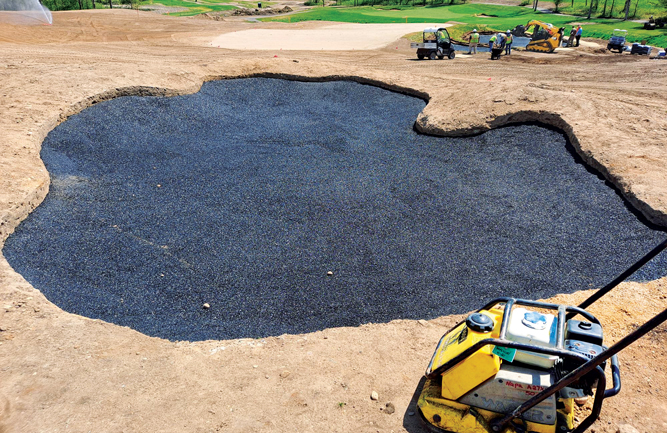
McKinnon calls the installation of Porous Pave’s Sand Guard, “pretty simple.”
It’s granite, rubber and a binder, he says. Mix the three ingredients into a cement mixer for 90 seconds, then pour it into the bunker.
“Usually, you use tubes to help spread it out, but it’s pretty simple, and then you roll it, and then you just let it dry,” McKinnon says. “It’s just like walking on a rubber mat when you come into your house. But it flexes with the amount of freeze/thaw we have here.”
More time with turf
With so much experience with Porous Pave, McKinnon has become something of an expert on the installation process. He doesn’t mind telling his colleagues of the advantages of having that liner in all his bunkers. And it’s not just about retiring the Nolte Sand Cleaner, which was meant for cleaning beaches.
“This liner flexes in the freeze/thaw process,” McKinnon says. “If you put something in there that’s a hard product, it would just bust apart. With Sand Guard by Porous Pave, if it gets damaged you can just cut it out, mix up a little and repair it, and its brand-new again.”
The Legacy Course at Cragun’s is a resort course, but it also hosts the Minnesota PGA Junior Match Play Championship every year, and for the last four years, they have hosted a PGA Tour Americas tournament called the CRMC Championship. This event looks like it will be around for years to come. For the Junior Match Play and the PGA tournament, the crew works to get the course in peak condition. When golfers see those conditions, it elevates the expectations of both the weekend resort golfers and the regular members. With the improved bunkers, McKinnon is thankful the crew is spending less time cleaning sand and more time maintaining grass.
“Since we’ve hosted the Juniors and the PGA Americas, expectations have gotten higher, because once that week comes, we provide a pretty good product,” McKinnon says. “We’ve invested a lot of money to keep people happy. Every day we’re raking, we’re flipping the sand. But we have a lot of acres to mow … the more we mow, the better it gets.”
Subscribe to Golfdom



If you enjoyed this article, subscribe to Golfdom to receive more articles just like it.