



How El Niño and La Niña impact snow mold in the Midwest
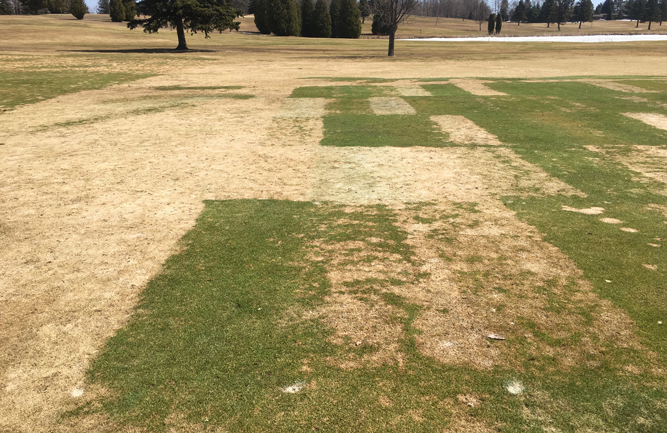
One of the biggest difficulties with snow mold control is that there is typically only one shot to get it right. Perhaps snow mold hasn’t been observed in years, so the decision was made to save a few bucks on the snow mold fungicide program. Then, of course, the worst winter in a decade arrives with feet of snow piling up outside.
At that point, you can’t really go remove the snow and apply more fungicide, so you’re basically left to wait and hope the damage isn’t too bad. This leads most superintendents to plan for the worst and often apply much more fungicide protection than they’ll probably need. But, as they say, better to plan for the worst than hope for the best.
But what if there was a way to accurately predict the conditions in certain winters? While this isn’t possible every winter given current forecasting capabilities, what about certain winters affected by La Niña and El Niño, which have well-documented impacts on snowfall and temperature?
Accurate snow mold predictions during these winters would allow superintendents to adjust their snow mold program based on the forecast for a severe or mild winter and apply just the right amount of protection to the turf.
What are El Niño and La Niña?
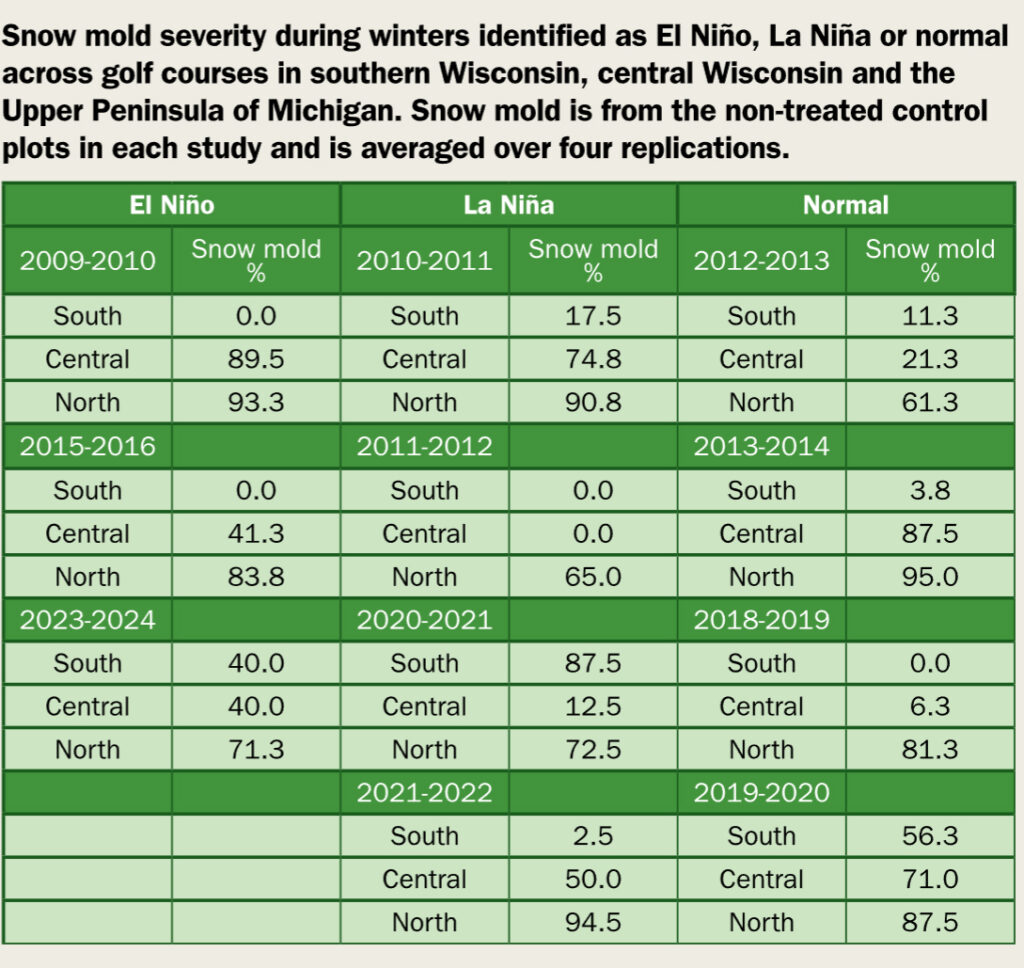
El Niño is the name given to warmer-than-average sea surface temperatures in the tropical Pacific Ocean near the equator, and La Niña is the name given when sea surface temperatures are cooler than average. Despite being thousands of miles from the U.S., they can have large impacts on winter conditions across the entire country (Figure 1).
In general, El Niño winters produce a more southern jet stream, causing cooler, wetter conditions in the South and warmer, drier conditions across the North. La Niña does the opposite, causing cooler, wetter conditions across the North and warmer, drier conditions across the South. Using these descriptions, we would expect snow mold in the Midwest, Northeast and Pacific Northwest to be above average during La Niña winters and below average during El Niño winters.
A “super El Niño” is forecast this winter, with water temperatures in the Pacific Ocean near the equator well above average. Does this mean superintendents across the northern U.S. can reduce their snow mold fungicide applications in anticipation of reduced snow mold pressure? Let’s see what the data from past El Niño and La Niña winters suggest.
How has snow mold in the Midwest responded to El Niño and La Niña winters?
At the University of Wisconsin –Madison, we have been studying snow mold across Wisconsin and surrounding states for decades. We have posted snow mold research results on our fungicide evaluation results page from every year dating back to 2008-2009.
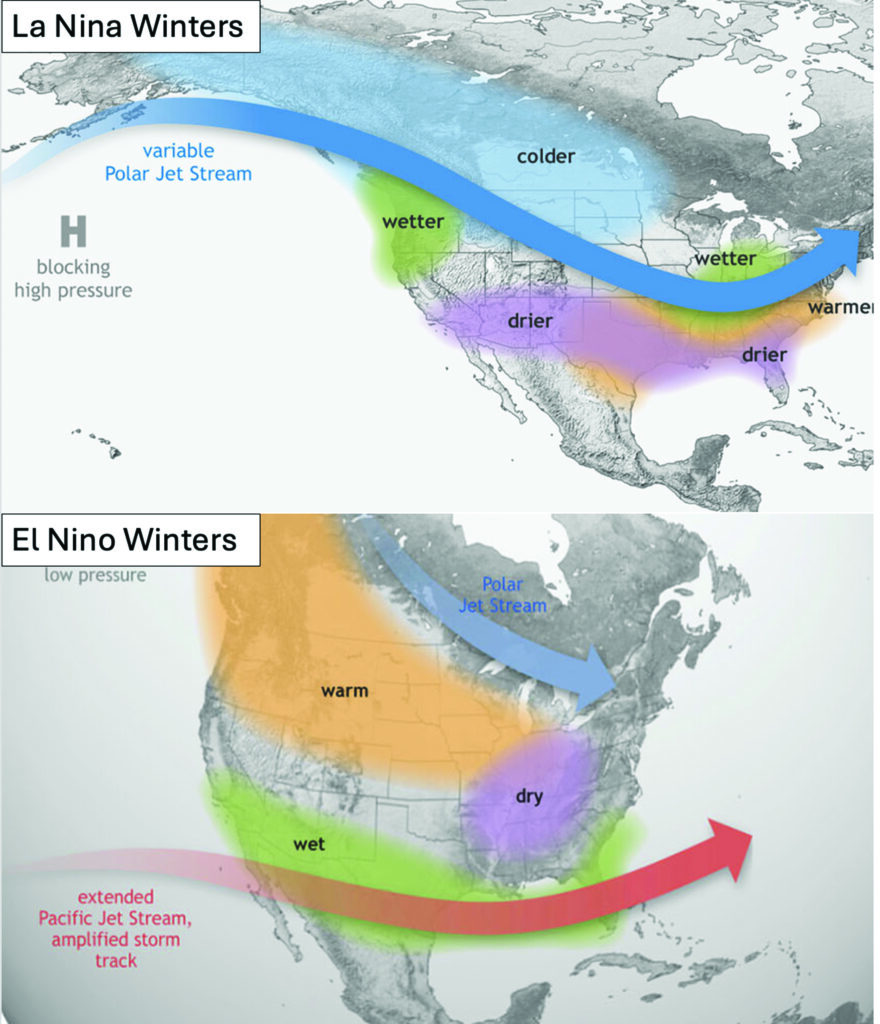
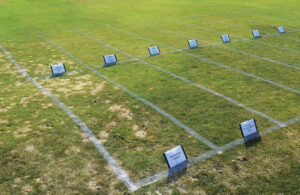
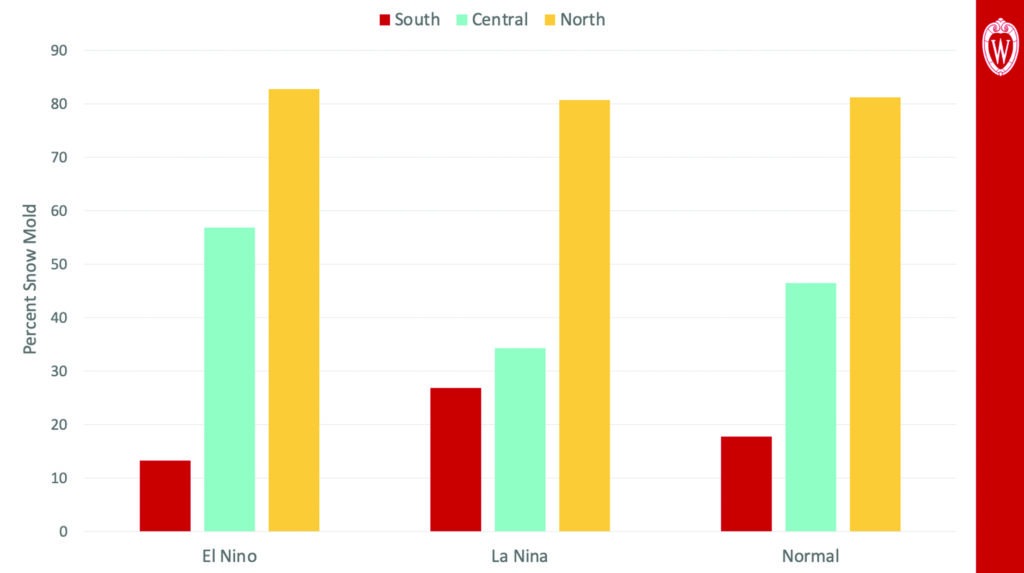
According to Golden Gate Weather Services, there were moderate or very strong El Niño winters in 2009-2010, 2015-2016 and 2023-2024, and moderate or strong La Niña winters in 2010-2011, 2011-2012, 2020-2021 and 2021-2022. During each of these winters, we tested snow mold at sites in southern Wisconsin (Madison or Milwaukee), central Wisconsin (Wausau or Stevens Point) or further north in Michigan’s Upper Peninsula (Marquette). The average snow mold on non-treated plots for each region in El Niño, La Niña and ‘normal’ winters are presented in Figure 2, and the individual data from each site is presented in Table 1.
In short, La Niña or El Niño winters were unable to accurately or consistently predict snow mold pressure across our testing locations. Looking at the overall averages, the region where winter appeared most impactful was the South, where the snow mold average of 27 percent in La Niña winters doubled the 13 percent in El Niño winters.
However, closer inspection revealed immense year-to-year variability. In both the 2009-2010 and 2015-2016 El Niño winters, no snow mold was observed in the southern locations, but in 2023-2024 (also an El Niño winter), snow mold damage averaged 40 percent. Snow mold in the La Niña winters of 2020-2021 averaged a very high 88 percent, but in 2010-2011, 2011-2012 and 2021-2022, the averages were 18 percent, 0 percent and 2.5 percent, respectively.
Snow mold at the central Wisconsin sites also didn’t follow any pattern related to El Niño or La Niña. What was more interesting was the gradual decrease in the level of snow mold observed at these locations over time. Snow mold at the central sites averaged nearly 55 percent before 2015 but only 38 percent after 2015.
This data supports what we’ve noticed anecdotally on the plots: Climate change has shifted central Wisconsin from an area that consistently experiences heavy snow mold damage every year to one that experiences it more sporadically, depending on the conditions of that particular winter.
If central Wisconsin has transitioned from one side of the snow mold divide to the other, further north in the Upper Peninsula, conditions remain firmly on the side of consistent snow mold pressure. Over the 11 years analyzed for this article, the lowest snow mold present in the north was 61 percent disease in 2012-2013 (a “normal” winter), and the highest was 95 percent in 2021-2022 (a La Niña winter).
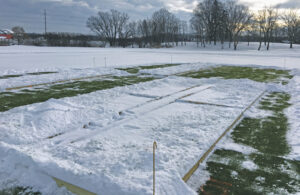
In the presumably lower snow mold pressure of El Niño winters in 2009-2010, 2015-2016 and 2023-2024, disease was 93 percent, 84 percent and 71 percent, respectively. When you’re this far north, it doesn’t really matter what the Pacific Ocean is doing — you’re going to get snow mold (Figure 3).
Conclusion
La Niña and El Niño can generally influence winter weather across the country, potentially causing devastating impacts such as increased flooding and expanded drought. But their influence remains just that: general.
Specific weather patterns at individual golf courses across the country will still vary in their winter environments, whether it’s a La Niña or El Niño year, resulting in varying levels of snow mold pressure no matter what’s happening in the Pacific Ocean. In addition, climate change is altering traditional winter patterns, so that what was needed to control snow mold at your location 20 years ago may no longer be needed.
The data presented in this article suggests that you shouldn’t alter your snow mold fungicide program based purely on whether it’s a La Niña or El Niño winter, but that doesn’t mean you shouldn’t alter your program at all.
Leave one or more non-treated check plots around the course each year to assess the level of snow mold pressure you experience and ensure you’re not applying more fungicide than needed. Keep up to date on new products and new restrictions on old products. And of course, keep up to date on the latest snow mold research from my program and others so that you are fully equipped to deal with this challenging disease.
Paul Koch, Ph.D., is professor of plant pathology at the University of Wisconsin-Madison, where he conducts research and provides information to professional turf managers on disease management and control. He can be reached at plkoch@wisc.edu.
Acknowledgements
Conducting this kind of research for decades takes a lot of support. First and foremost, Kurt Hockemeyer is our field research manager and expertly manages the logistics of a large, complex program. Second, private industry sponsors provide the essential funding to conduct the research. Lastly, this work can’t be done without the support of our host superintendents. Since 2009, we’ve tested at the following locations with the following superintendents and are immensely thankful for their support:
• Grant Park GC – Jon Canavan
• Marquette CC – Craig Moore
• O.J. Noer Turfgrass Research Facility – Tom Schwab/Bruce Schweiger/Dave Marach
• SentryWorld GC – Gary Tanko/Matt Smith
• Wausau CC – Aaron Hansen
• Wawonowin CC – Glen Rochester
Subscribe to Golfdom



If you enjoyed this article, subscribe to Golfdom to receive more articles just like it.