




Fairy ring control: Timing, placement and product choice matter
A search of Plant Disease Management Reports found four fairy ring trials published in 2020-2022, all on bermudagrass putting greens. Three studies were conducted at North Carolina State University, and one was conducted at Clemson University. Both preventive and curative studies evaluated a range of fungicides.

Briskway + Revolution provides excellent fairy ring suppression
This study was conducted on a Champion bermudagrass putting green at NC State University (4). Treatments were applied using 2 gal/1,000 ft² of water and immediately watered in with 0.2 inches of irrigation. Applications occurred monthly from April through September.
The trial included three fungicides, Briskway (azoxystrobin + difenoconazole), Posterity (pydiflumetofen), Velista (penthiopyrad) and the nematicide Divanem (abamectin), plus Revolution wetting agent with each treatment.
Fairy ring severity was visually assessed from July through September as percent area of the plot exhibiting symptoms. Normalized Difference Vegetation Index (NDVI) was assessed using a FieldScout CM1000 from July through September.
The strongest result was Briskway at 1.2 fl oz/1,000 ft² + Revolution at 6 fl oz, with zero fairy ring AUDPC, compared with 127.4 for the untreated control. Briskway at 0.9 fl oz was also excellent (Table 1).
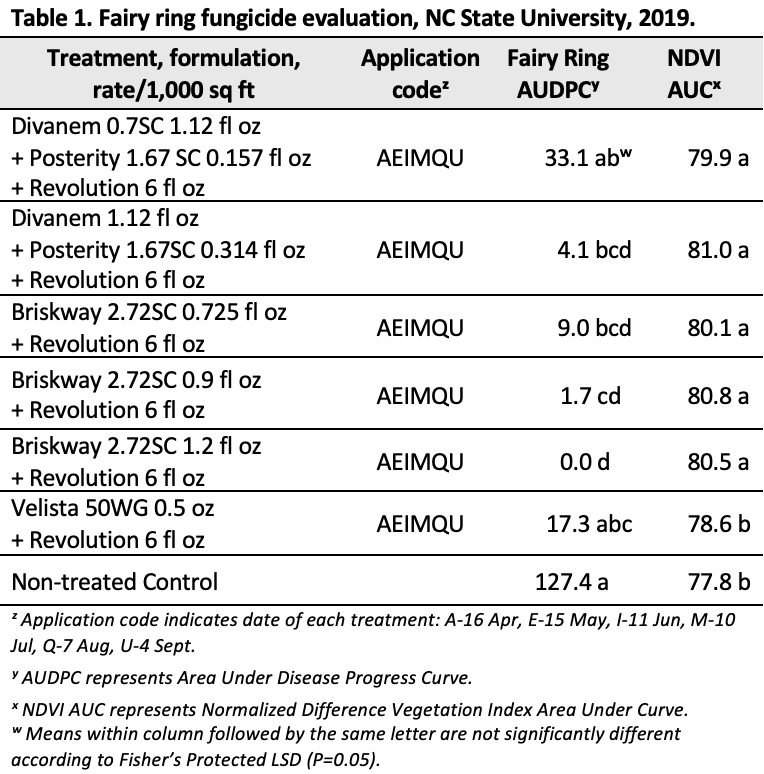
The lower Divanem + Posterity + Revolution combination and Velista + Revolution were not statistically different from the untreated plots for fairy ring suppression.
The trial shows that treatments containing SDHI or QoI fungicides did not provide equivalent fairy ring suppression, even though all were paired with the same wetting agent.
Curative fairy ring control: Speed matters
This is probably the most useful PDMR report in the group because it specifically examined curative treatment of established fairy ring on a TifEagle bermudagrass putting green. The research was conducted at Clemson University (3).
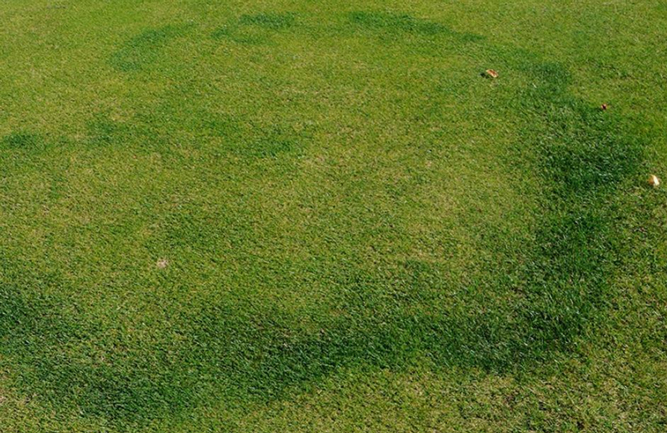
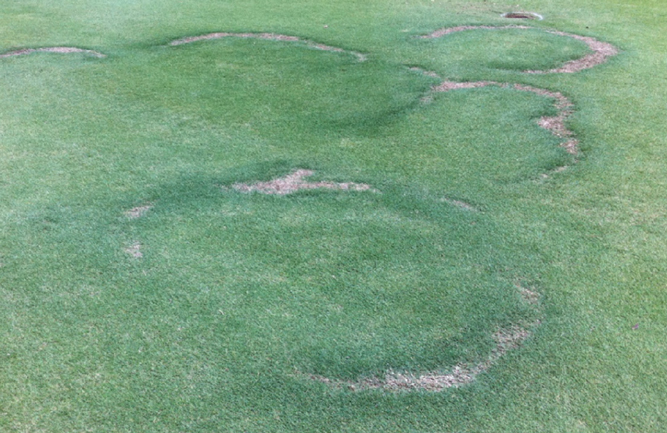
Lycoperdon spp. was identified as the fairy ring disease organism. Active Type II rings were present at treatment initiation, and drought later resulted in Type I symptoms in untreated turf (See Figure 1).
Fungicide treatments included Rayora (flutriafol), Maxtima (mefentrifluconazole) and Headway (azoxystrobin + propiconazole).
All fungicides ultimately reduced symptoms, but Rayora acted considerably faster (Table 2). Rayora-treated plots were already significantly improved by June 23, whereas Maxtima and Headway did not separate statistically from the untreated control until July 20.
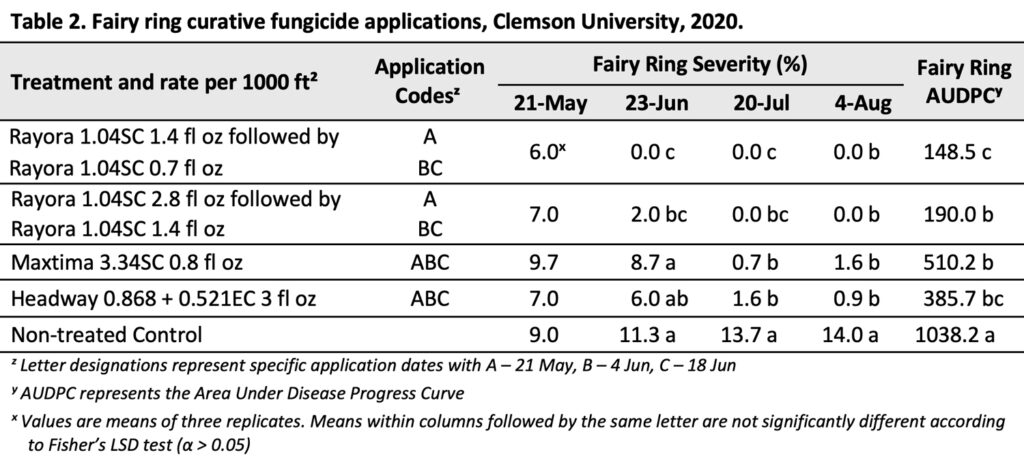
By Aug. 4, symptoms were essentially absent from all fungicide treatments, while untreated turf averaged 14 percent fairy ring.
The practical point is that fungicides can differ substantially in how quickly they suppress established fairy ring symptoms.
Densicor on the preventive control of fairy ring on bermudagrass greens
This NC State University study used a 9-year-old Champion bermudagrass USGA putting green (1). The fairy ring organism was reported as Marasmius oreades.
Applications were made at 2 gal/1,000 ft² of water carrier and began April 14, with reapplications at 14-, 21- or 28-day intervals. Treatments were irrigated immediately after application with 0.125 inches of water. Fungicides included Densicor (prothioconazole), Mirage (tebuconazole) and ProStar (flutolanil), each combined with Revolution wetting agent.
Phytotoxicity was rated as a percent chlorosis or yellowing of each plot. Fairy ring and leaf spot symptoms were assessed as a visual estimation of the percent diseased area within each plot.
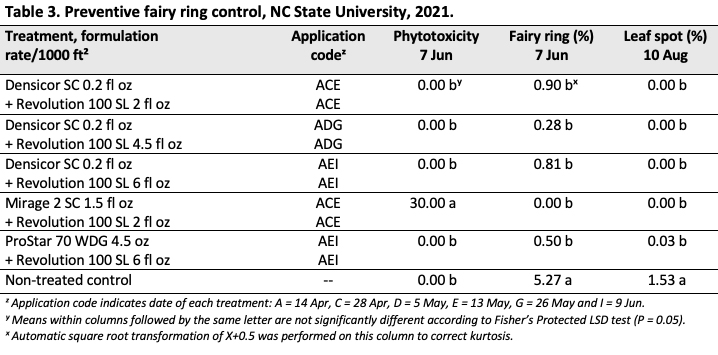
All treatments significantly suppressed fairy ring. Untreated plots averaged 5.27 percent fairy ring, compared with Densicor + Revolution (0.28-0.90 percent), ProStar + Revolution (0.50 percent) and Mirage + Revolution (0 percent).
However, the Mirage + Revolution treatment produced 30 percent chlorosis, an important turf-safety result.
This is good evidence that the fungicide + surfactant + immediate irrigation strategy is highly effective preventively. The results also illustrate an important tradeoff that excellent disease suppression does not necessarily mean acceptable turf safety, as Mirage + Revolution produced 30 percent chlorosis.
Preventive fairy ring control delivers added dollar spot suppression
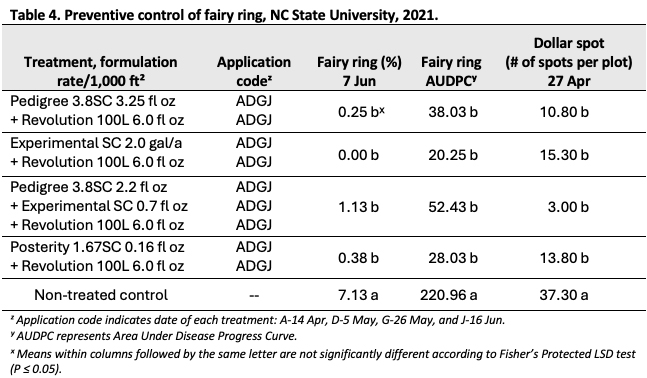
Again, this research was a 9-year-old Champion bermudagrass green with a USGA rootzone at NC State University (2).
Applications began April 14 and were repeated every 21 days, with immediate irrigation of 0.125 inches after treatment. Fungicide treatments included Pedigree (flutolanil), Posterity (pydiflumetofen) and an experimental product. Every treatment also included Revolution at 6 fl oz/1,000 ft².
All treatments significantly suppressed fairy ring throughout the experiment. No statistical differences emerged among the fungicide treatments, but all were much better than the untreated control.
These preventive fairy ring treatments also provided a notable benefit by significantly reducing dollar spot.
The pattern that emerges
The PDMR work supports several fairly strong conclusions.
Preventive treatments are consistently reliable. The 2019 and 2021 NC State trials show very strong suppression when fungicides are applied before severe symptom development.
Application methods consistently emphasized fungicide placement. The NC State preventive trials used roughly 2 gal carrier/1,000 ft² followed immediately by 0.125–0.20 inch irrigation, reinforcing recommendations to move fairy ring fungicides into the thatch and root zone rather than leaving them on the foliage.
Wetting agents were a consistent component of successful preventive programs, although these trials did not isolate their contribution.
Curative control is possible. The Clemson TifEagle experiment is especially valuable here. Even an established Lycoperdon fairy ring responded, although Rayora produced substantially faster suppression than Maxtima or Headway.
Pathogen identity may help explain variable field response. These reports involve an unidentified basidiomycete, Lycoperdon spp., Marasmius oreades and “various basidiomycetes.” That fits the broader fairy ring literature showing that fairy ring is not one pathogen/disease interaction, but a disease complex involving many basidiomycetes.
Research takeaways
- Preventive fungicide programs provided consistently strong fairy-ring suppression when initiated before severe symptoms developed.
- Application technique was consistent across successful NC State programs using approximately 2 gal/1,000 ft² carrier followed by immediate irrigation to move fungicides into the thatch/root zone.
- Wetting agents were routinely included in successful preventive programs, although their independent contribution was not tested.
- Curative control is possible, but products can differ substantially in the speed of symptom suppression.
- Fairy ring is a disease complex caused by numerous basidiomycete fungi, which may contribute to variable treatment responses.
Sources:
- Butler, L. W., Freund, D. R., Ploetz, J. N., Butler, E. L., & Kerns, J. P. (2022). Evaluation of Densicor on the preventative control of fairy ring on bermudagrass greens, 2021. Plant Disease Management Reports, 16:T010.
- Hampy, H. D., Ploetz, J. N., Freund, D. R., Butler, E. L., & Kerns, J. P. (2022). Evaluation of Pedigree and experimental products on the preventative control of fairy ring on bermudagrass greens, 2021. Plant Disease Management Reports, 16:T017.
- Roberts, J., McBride, L., Lynn, A., & Rolfe, S. (2021). Evaluation of conventional fungicides for curative control of fairy rings in ultradwarf bermudagrass putting green turf, 2020. Plant Disease Management Reports, 15:T030.
- Stephens, C. M., Butler, E. L., Galle, G. H., Ploetz, J. N., & Kerns, J. P. (2020). Evaluation of fungicides for control of fairy ring on a bermudagrass putting green, 2019. Plant Disease Management Reports, 14:T010.
Subscribe to Golfdom



If you enjoyed this article, subscribe to Golfdom to receive more articles just like it.