




Annual bluegrass management: What 20 years of research now shows
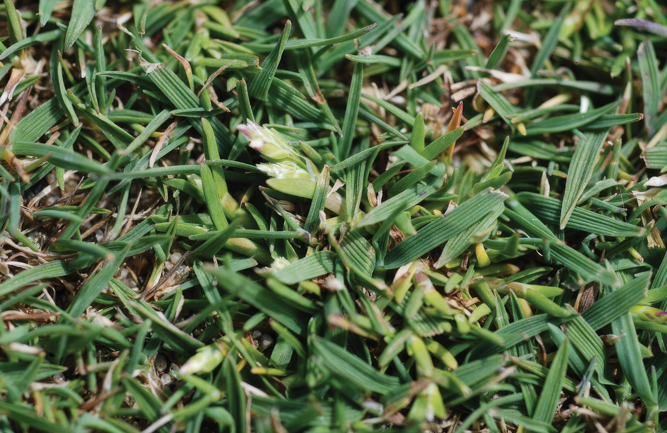
Walk onto almost any golf course in America, and you will see annual bluegrass (Poa annua) staring back at you. Many superintendents loathe it, some tolerate it and others have made peace with it.
But whether annual bluegrass is a nuisance, a nemesis or a necessary reality, nobody denies that it is one of the most adaptive, resilient and economically influential plants in turfgrass management.
That is why the recent virtual issue from Crop, Forage and Turfgrass Management (CFTM), highlighting more than 20 years of research on annual bluegrass, is a gold mine.
The researchers effectively bundled the major threads of annual bluegrass science into one place. The articles summarize how it grows, why it persists, how it responds to herbicides and what superintendents can do about it.
And the takeaway is that managing annual bluegrass is not about chasing a weed. Instead, it is about understanding an ecological system. Across dozens of studies, the message is that annual bluegrass wins when the environment favors it but loses when conditions favor something else.
Here is what science tells us and what it means to manage this troublesome weed.
Silent engine behind Poa’s success
If annual bluegrass has a superpower, it is that it never stops producing seed. Even when it looks dormant, stressed or beaten back, Poa is replenishing a seedbank that keeps your greens, fairways and roughs vulnerable year after year.
Early seed viability
One of the most essential articles (3) in the virtual issue showed that annual bluegrass seed becomes viable very early in spring, often weeks before many managers begin thinking about seedhead suppression or preemergent herbicide application timing. In some locations, viable seed appears while golfers are still wearing their winter jackets.
The management calendar needs to address:
- Seedbank replenishment begins earlier than previously assumed.
- Spring-only programs often start too late.
- Fall and winter are now additional management windows.
This research explains why some superintendents feel like they are always behind on annual bluegrass even when they follow conventional timing. Germination was happening earlier than the old programs accounted for.
Seedhead suppression three-season strategy
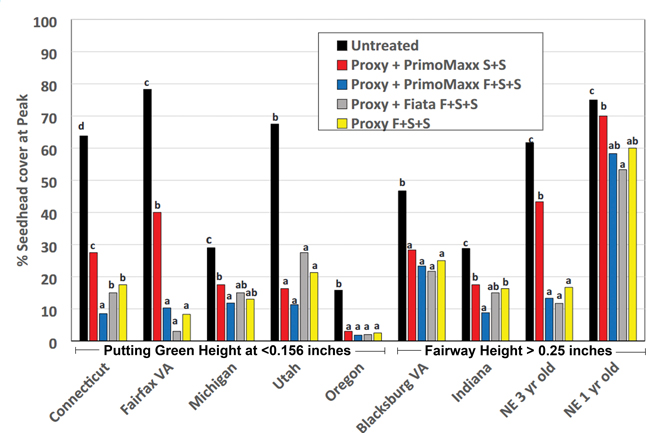
Ask how to suppress annual bluegrass seedheads, and we often hear, “Hit it with Proxy in the spring.” For decades, this was the norm. But spring-only seedhead suppression is outdated. The new approach spans spring, fall and winter, with fall applications playing an important role.
Researchers (5,11) demonstrated that adding one Proxy (ethephon) application in late fall or early December dramatically improves seedhead suppression the following spring. This extra winter application reshapes the curve of seedhead emergence.
Other research (10) suggests that combining winter ethephon with mineral oil further intensifies suppression, particularly in years with erratic spring weather.
These treatments work because, instead of reacting to seedhead emergence, it is best to anticipate their return. This change in management aligns product applications with the biology and environment of annual bluegrass rather than with traditional calendar recommendations.
Long-term strategy needed
The turfgrass industry wants a silver bullet, but annual bluegrass is the ultimate proof that one is difficult to find. A comprehensive management study (9) looked at control strategies over multiple years on putting greens across several universities. The group of researchers concluded that no single product or tactic can control annual bluegrass. Instead, a winning management system has five things in common:
- Fall preemergent herbicides applied on time and rotated wisely.
- Postemergent control of escapes, not letting patches mature.
- Seedhead suppression using multiseason plant growth regulator (PGR) programs.
- Consistent cultural practices such as topdressing, grooming and verticutting.
- Years of patient implementation.
Their message is that, with a different strategy every year, annual bluegrass will win the battle. Put simply, the issue is not the weed itself, but rather a lack of a consistent long-term plan.
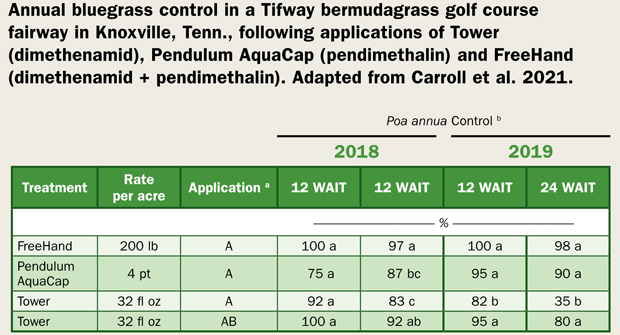
a) Treatments were applied A = Oct. 17, 2018, or Oct. 15, 2019, and B = Dec. 3, 2018, or Dec. 4, 2019
b) Poa annua control visually rated 12 and 24 weeks after initial application (WAIT) on a scale of 0 percent (no control) to 100 percent (complete control). Means in a column followed by the same letter are not significantly different (P < 0.05). (Graphic: Golfdom staff)
Renovation may be the answer
There comes a point, usually around 60-80 percent infestation, when annual bluegrass is no longer a weed. It is the dominant species, and in these situations, renovation may be more efficient than continual suppression.
Research demonstrated a practical solution (8). By combining herbicides with overseeding perennial ryegrass, the Poa-dominated turf transitioned to a more manageable stand. They did not achieve a complete conversion to perennial ryegrass, but a targeted, economical correction. This approach is valuable because:
- You regain control of the dominant species.
- Renovation avoids a multiyear struggle.
- It gives managers a middle option between living with Poa and trying to eliminate it.
No breaks for warm-season grasses
For bermudagrass, annual bluegrass pressure in winter is relentless. One of the most practical warm-season studies (2) evaluated combinations of Tower (dimethenamid) and Pendulum AquaCap (pendimethalin) in bermudagrass (see Table 1). Their key findings:
- Application timing matters more than preemergent selection.
- Mixtures provide more reliable suppression.
- Injury to bermudagrass was minimal when applications were aligned with soil temperature.
For warm-season turf managers in the transition zone, these recommendations can safely and consistently suppress annual bluegrass without sacrificing bermudagrass health.
Herbicide resistance is real
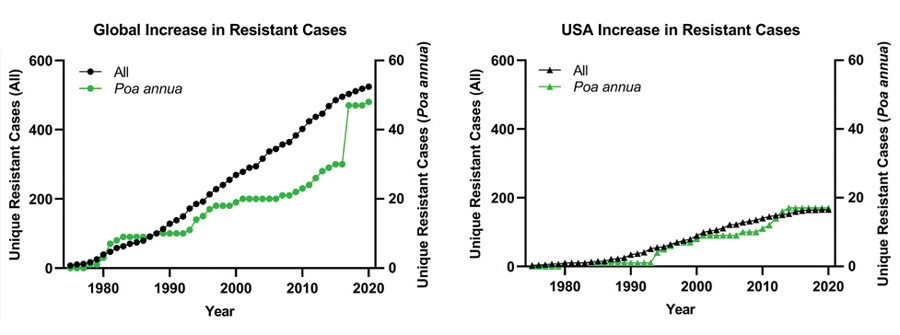
The rapid rise of herbicide-resistant annual bluegrass populations is now well documented. Resistance in Tennessee was the first wake-up call. A University of Tennessee golf course survey confirmed resistance to photosystem II (PSII) inhibitors, very-long-chain fatty acid (VLCFA) inhibitors and other commonly used herbicide modes of action (1). This was not a single course or region, but widespread throughout the country.
Additional studies have found ethofumesate-resistant annual bluegrass in several different states as well (12). This was unfortunate, since ethofumesate had been a cornerstone of Poa control for decades. Reduced efficacy indicates a notable development, as the weed is adapting at a rate that surpasses many chemical control strategies.
What this means for golf courses is that a single chemical control is not a long-term solution for annual bluegrass control.
There is a forward-looking approach that reframes annual bluegrass control entirely (6). Instead of focusing solely on products, it presents a practical, operational framework for Integrated Weed Management (IWM). Key points of IWM include:
- Using intentional cultural practices to reduce Poa competitiveness.
- Designing mechanical interventions that limit seed production.
- Adding chemical diversity instead of relying on one or two modes of actions (MOAs).
- Making economic decisions based on thresholds and cost-benefit.
This is a management philosophy that recognizes that annual bluegrass is not a chemical problem but an ecological one, and how IWM can move the golf course industry forward.
What science says now
Everything is pulled together in a comprehensive scientific summary of annual bluegrass (7), and the takeaways are:
- Annual bluegrass includes both annual and perennial biotypes, explaining why it persists despite treatments aimed at “annual” cycles.
- Many turf practices unintentionally favor annual bluegrass, including overwatering, excessive nitrogen and aggressive low mowing.
- The species thrives in stress environments — traffic, compaction, shade — where bentgrass and bermudagrass falter.
- Sustainable suppression requires aligning turfgrass ecology with management goals, not merely applying more chemicals.
In other words, annual bluegrass is a weed that can adapt because our current management system allows it to.
A new era of Poa management
Annual bluegrass has been a complex problem for a long time, not because it is invincible, but because it adapts faster than our management solutions. It takes advantage of every narrowly focused management practice attempted. The virtual issue in CFTM emphasizes that annual bluegrass can be controlled, but this requires viewing it as part of a system rather than treating it as just a weed.
Understanding phenology, climate adaptation, diversifying chemistry, adjusting cultural practices, reducing seedbank inputs and returning to fundamental agronomy are the long-term strategies that reshape the playing field.
This body of research does not just tell us what annual bluegrass is; it tells us what it responds to and, finally, what we can do about it.
For more information, go to the virtual issue Annual Bluegrass (Poa annua): A Troublesome Weed: CFTM. Aaron Patton, guest editor. Last updated April 10, 2025.
References
1. Brosnan, J. T., Vargas, J. J., Breeden, G. K., & Zobel, J. M. (2020). Herbicide resistance in annual bluegrass on Tennessee golf courses. Crop, Forage & Turfgrass Management, 6(1), e20050.
2. Carroll, D. E., Brosnan, J. T., & Breeden, G. K. (2021). Annual bluegrass control in bermudagrass using dimethenamid and pendimethalin. Crop, Forage & Turfgrass Management, 7(1), e20083.
3. Carroll, D. E., Brosnan, J. T., McCurdy, J. D., DeCastro, E. B., Patton, A. J., Liu, W., & Westbury, D. B. (2021). Germinability of annual bluegrass seed during spring in the Eastern United States. Crop, Forage & Turfgrass Management, 7(1), e20117.
4. Heap, I. M. (2023). International survey of herbicide resistant weeds. WeedScience.
5. McCullough, P. E., Hart, S. E., & Lycan, D. W. (2005). Plant growth regulator regimens reduce Poa annua populations in creeping bentgrass. Applied Turfgrass Science, 2, 1–5.
6. McCurdy, J. D., Bowling, R. G., DeCastro, E. B., Patton, A. J., Kowalewski, A. R., Mattox, C. M., & Bagavathiannan, M. (2023). Developing and implementing a sustainable, integrated weed management program for herbicide-resistant Poa annua in turfgrass. Crop, Forage & Turfgrass Management, 9(1), e20225.
7. McCurdy, J. D., Bowling, R. G., DeCastro, E. B., Patton, A. J., Kowalewski, A. R., Mattox, C. M., & Bagavathiannan, M. (2025). Poa annua ecology, biology, and integrated weed management practices in turfgrass. Crop, Forage & Turfgrass Management, 11(1), e70019.
8. , B. S., Elmore, M. T., & Murphy, J. A. (2019). Using herbicides and perennial ryegrass to renovate turf dominated by annual bluegrass. Crop, Forage & Turfgrass Management, 5(1), 190005.
9. Patton, A. J., Braun, R. C., Schortgen, G. P., Weisenberger, D. V., Branham, B. E., Sharp, B., Sousek, M. D., Gaussoin, R., & Reicher, Z. J. (2019). Long-term efficacy of annual bluegrass control strategies on golf course putting greens. Crop, Forage & Turfgrass Management, 5(1), e180068.
10. Raudenbush, Z., Elmore, M. T., Nangle, E. J., Sorochan, J. C., Brosnan, J. T., & Askew, S. D. (2020). December ethephon applications in combination
Subscribe to Golfdom



If you enjoyed this article, subscribe to Golfdom to receive more articles just like it.