




New nematode management research on bermudagrass
Nematodes are a persistent underground pest in southern turfgrass, feeding on roots and weakening the plant. Recent research in Alabama conducted by William Groover, Ph.D., at Auburn University, examined nematodes, focusing on when they are most active, how to manage them and how new tools might help turf managers stay ahead of the problem.
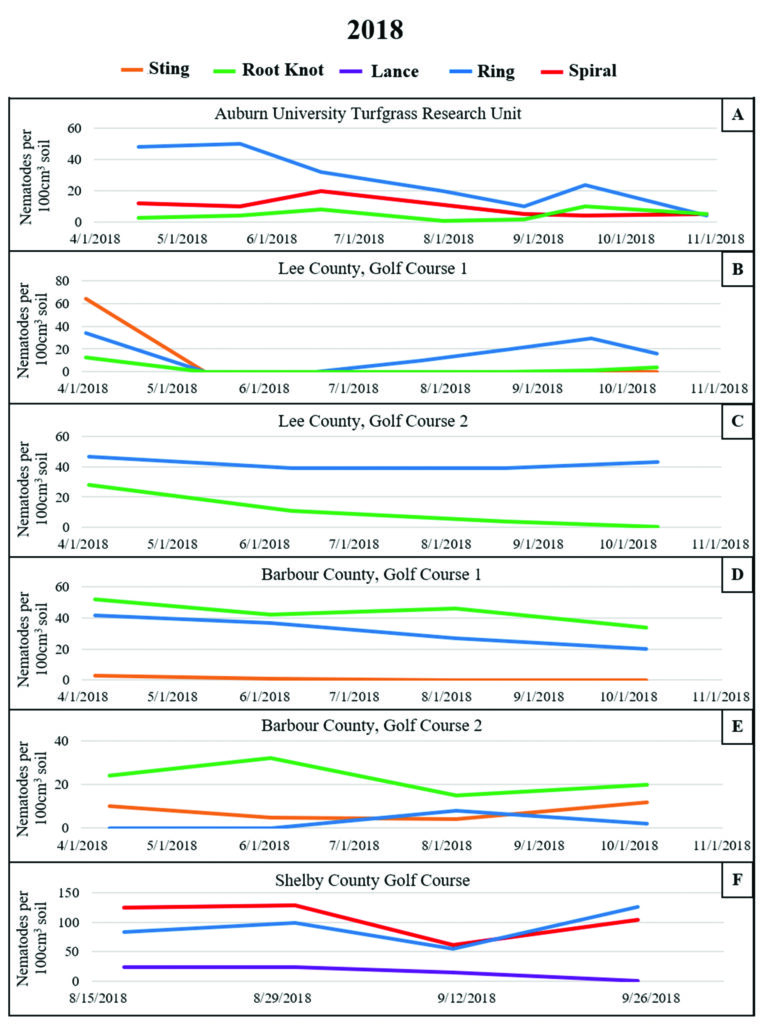
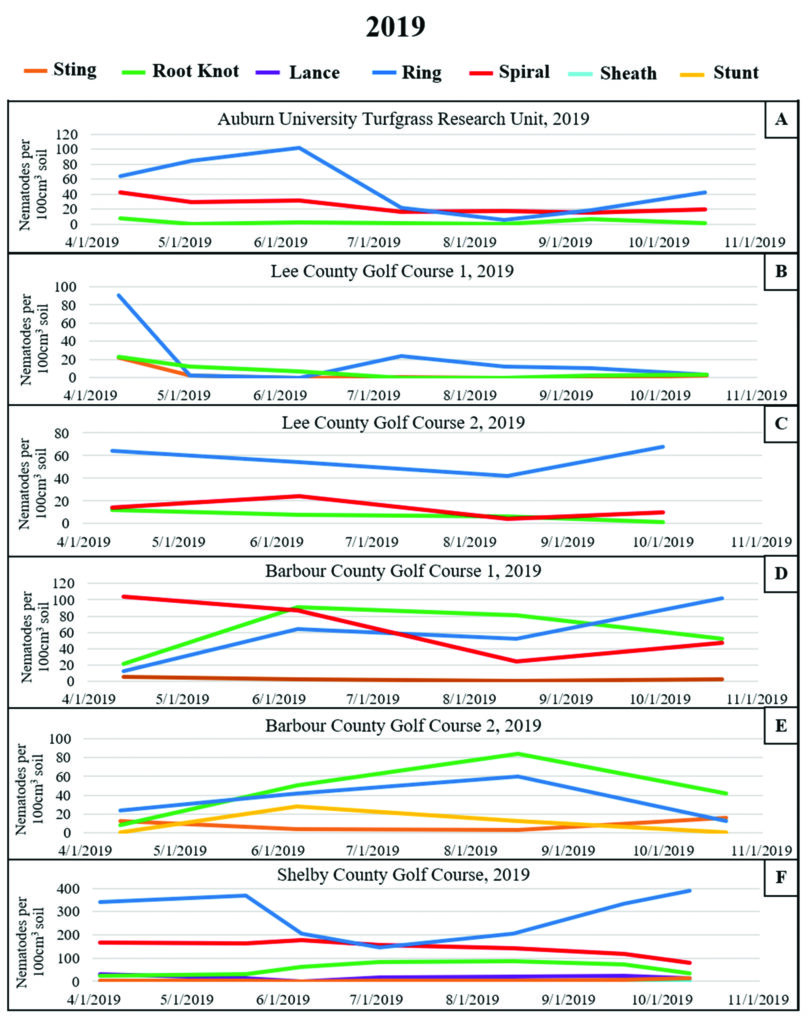
A statewide survey across six highly maintained bermudagrass sites in 2018 and 2019 revealed a surprising level of diversity. Seven genera of plant-parasitic nematodes were identified, but only the sting nematode (Belonolaimus) and the root-knot nematode (Meloidogyne) reached damaging levels. Their populations fluctuated with the seasons. Sting nematodes peak in spring and fall and root-knot nematodes during the heat of summer. These patterns demonstrate the importance of year-round soil sampling.
Building on that foundation, Groover evaluated Reklemel (fluazaindolizine, Corteva Agriscience), a new nematicide, for its potential to manage nematodes while improving turf performance. Across greenhouse, microplot and field trials, Reklemel consistently reduced sting and root-knot populations and often improved turf quality and normalized difference vegetation index (NDVI) readings.
Finally, Groover tested remote sensing technologies to track turf health in nematode-infested sites. By pairing visual quality ratings with NDVI and the normalized difference red edge index (NDRE), he found strong correlations between reduced nematode populations and improved plant vigor. This approach could use drones or handheld sensors to monitor nematode impact more efficiently across large turf areas.
Together, these studies point toward a more integrated approach to nematode management — combining seasonal awareness, practical chemical tools and precision monitoring technology to keep bermudagrass healthy and resilient year-round.
Nematode distribution in Alabama
Soil samples were collected from six locations (five golf courses and the Auburn University Turfgrass Research Unit) during the 2018 and 2019 growing seasons. All sites had hybrid bermudagrass and are reported by county: one in Shelby County, two in Barbour County and two in Lee County.
At each location, one green with a history of nematodes was selected for sampling, or, if unknown, a randomly chosen green. Each sampling event involved collecting ten soil cores, which were then mixed into a single sample. Sampling occurred from April through October in both years, with some sites sampled monthly and others every other month.
In the laboratory, a 100 cm³ (~6 in³) subsample from each green was processed to determine the population density of plant-parasitic nematodes. Identification was made to the genus level using established taxonomic keys. Population data were compared against action thresholds, which indicate when nematicide treatment may be justified. For example, threshold levels were 10 sting nematodes, 80 root-knot nematodes and 1,000 stunt nematodes per 100 cm³ of soil.
The two-year survey across Alabama golf courses revealed that nematode populations in hybrid bermudagrass vary widely by season and species. Consistent sampling throughout the growing season is essential for accurate diagnosis and control.
During the 2018 season (Figure 1a), five genera of plant-parasitic nematodes were identified: sting (Belonolaimus longicaudatus), lance (Hoplolaimus), root-knot (Meloidogyne), ring (Mesocriconema) and spiral (Helicotylenchus). Ring nematodes were found on every site, but never at damaging levels. Only sting nematode populations exceeded action thresholds, occurring in April and October at the tested greens in Lee and Barbour counties.
In 2019, seven genera were detected, including all from 2018 plus sheath (Hemicycliophora) and stunt (Tylenchorhynchus) nematodes (Figure 1b). Ring nematodes again appeared on nearly all samples but remained below treatment levels. Sting nematodes surpassed thresholds at four sampling points, while root-knot nematodes reached damaging levels in five samples, mainly during June through September.
Two courses (one in Lee County and Barbour County) illustrated the impact of proactive management. Golf Course 1 in Lee County implemented a nematicide program after detecting high sting nematode counts in spring and successfully reduced populations below threshold levels. In contrast, the Barbour County courses took no corrective action and saw population densities rebound in the fall.
Root-knot nematodes showed the opposite pattern, with populations peaking in late summer as sting nematode numbers declined. This inverse relationship aligns with previous research showing that sting nematodes prefer cooler soil temperatures (~86°F), while root-knot nematodes thrive in warmer midsummer conditions.
Groover’s research is the first report of seasonal nematode fluctuations on turfgrass in Alabama and reinforces the need to sample more than once per growing season. Populations of damaging nematodes can rise and fall dramatically between spring, summer and fall. Routine monitoring at multiple points throughout the season provides the best foundation for timing nematicide applications.
Evaluation of Reklemel
At Auburn University, Groover evaluated Reklemel for its ability to manage sting and root knot nematodes. Trials were conducted under greenhouse, microplot and field conditions during 2018 and 2019 to compare Reklemel’s performance with Indemnify (fluopyram) and an untreated control.
Three Reklemel rates were tested: low (30 ounces per acre, applied four times at four-week intervals), medium (62 ounces per acre, applied twice at zero and eight weeks) and high (123 ounces per acre, single application). Indemnify was applied twice at 8.6 ounces per acre, while tap water served as the untreated control.
Greenhouse studies tested Reklemel against both nematodes using Princess 77 bermudagrass grown in sand. After six weeks of establishment, pots were inoculated with either root knot or sting nematodes and treated according to the test schedule. Turf vigor was rated weekly, and NDVI was measured. Nematode counts were taken 84 days after the first application.
To validate results under semi-field conditions, the same treatments were applied to 7-gallon sand-filled pots containing Tifway bermudagrass sod maintained as a fairway. Half of the microplots were inoculated with root knot and half with sting nematodes. Trials were conducted over two years with regular turf quality and NDVI ratings. Nematode populations were sampled three to four times per season.
Full-scale field studies were carried out at the Auburn University Gulf Coast Research and Extension Center in Fairhope, Ala., on common bermudagrass fairway turf naturally infested with sting and root-knot nematodes. Plots measured 5-by-10 feet and received identical treatments to those in the greenhouse and microplot studies.
Data collection included visual turf ratings, NDVI readings and drone-based aerial imagery using a MicaSense RedEdge-M sensor. Images were analyzed to generate NDVI and NDRE maps that tracked turf health throughout the season.
Results for Reklemel
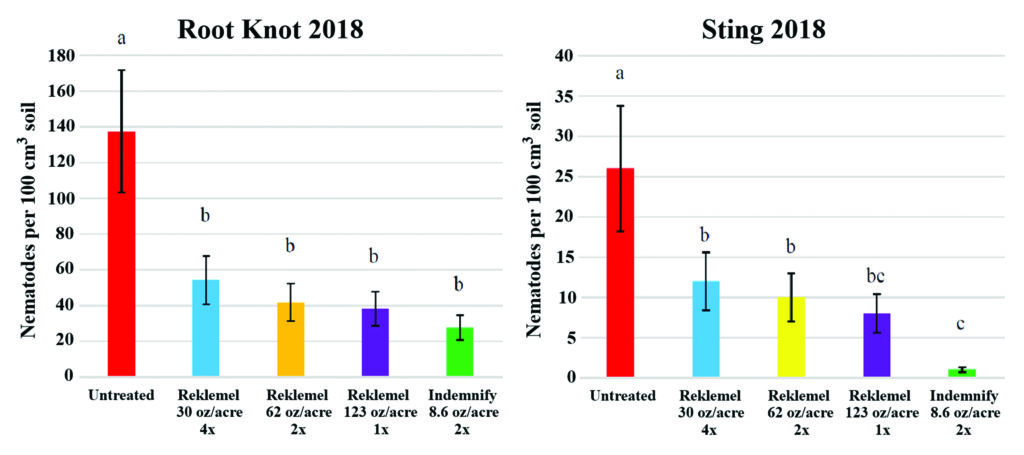
In 2018 greenhouse trials, all nematicide treatments significantly reduced root-knot and sting nematode populations compared with untreated controls (Figure 2). Indemnify (8.6 oz/acre) and the highest rate of Reklemel (123 oz/acre) provided best suppression of sting nematodes. Similar trends were observed in 2019, although differences among treatments were less distinct.
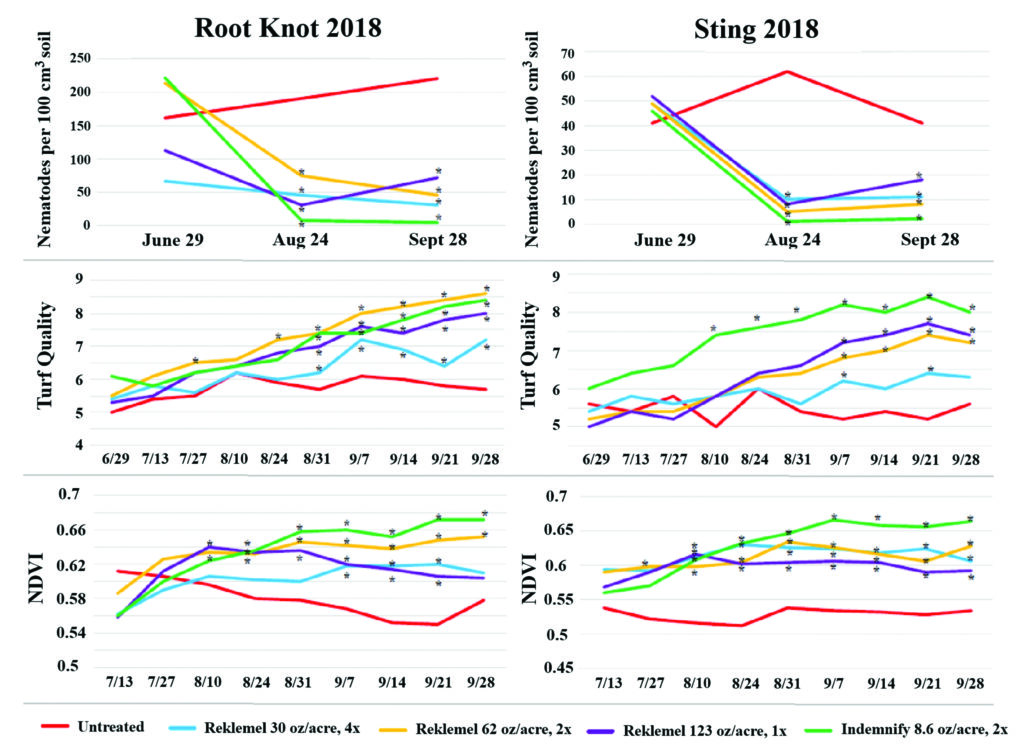
When tested under semi-field conditions in large sand-filled microplots, Reklemel again demonstrated strong nematicide activity (Figure 3). Against root-knot, all rates reduced populations below damaging levels and improved turf appearance. The medium (62 oz/acre) and high (123 oz/acre) rates consistently produced the best turf quality and NDVI readings, rivaling Indemnify in performance.
For sting, all nematicide treatments significantly reduced nematode populations and improved turf quality and NDVI values in both 2018 (Figure 3) and 2019 (data not shown). In general, as nematode counts dropped, turf color and density improved.
In the larger field trial, Reklemel performed comparably to Indemnify in reducing sting and root-knot nematode populations during both 2018 and 2019 (data not shown). Although population reductions were significant at nearly all sample dates, visual turf differences were not detected, likely because the fairway turf showed no visible nematode damage before treatment.
Remote sensing evaluation of nematicides
Groover also conducted microplot and field trials in 2018 and 2019 to evaluate the effectiveness of Divanem (abamectin), Indemnify (fluopyram), Nimitz Pro G (fluensulfone) and Multiguard Protect (furfural) on bermudagrass infested with sting and root-knot nematodes.
In field microplots, sand-filled plastic pots were arranged in a randomized complete block design with five replications per treatment. Tifway bermudagrass sod was established under automated drip irrigation and maintained at a 1-inch mowing height. Half of the plots were inoculated with root-knot (50,000 eggs per pot), while the other half received sting (100 nematodes per pot).
Nematicides were applied once at the start of the trial. All materials were watered in with 0.25 inches of irrigation. Evaluations occurred 30 and 60 days after treatment (DAT) and included nematode counts, visual turf quality ratings (1–9 NTEP scale) and multispectral indices (NDVI and NDRE).
A 2019 field trial at Montevallo (Ala.) Golf Club tested the same nematicides on four putting greens with known nematode infestations. Each green was divided into quadrants for replicated treatments: untreated, Divanem, Indemnify and Nimitz Pro G.
Soil cores were collected every 28 days for nematode quantification, while turf quality, NDVI and NDRE were measured both on the ground and via drone imagery. Flights were standardized for solar conditions and analyzed using Pix4Dmapper and ArcGIS to calculate vegetation indices.
Results and discussion
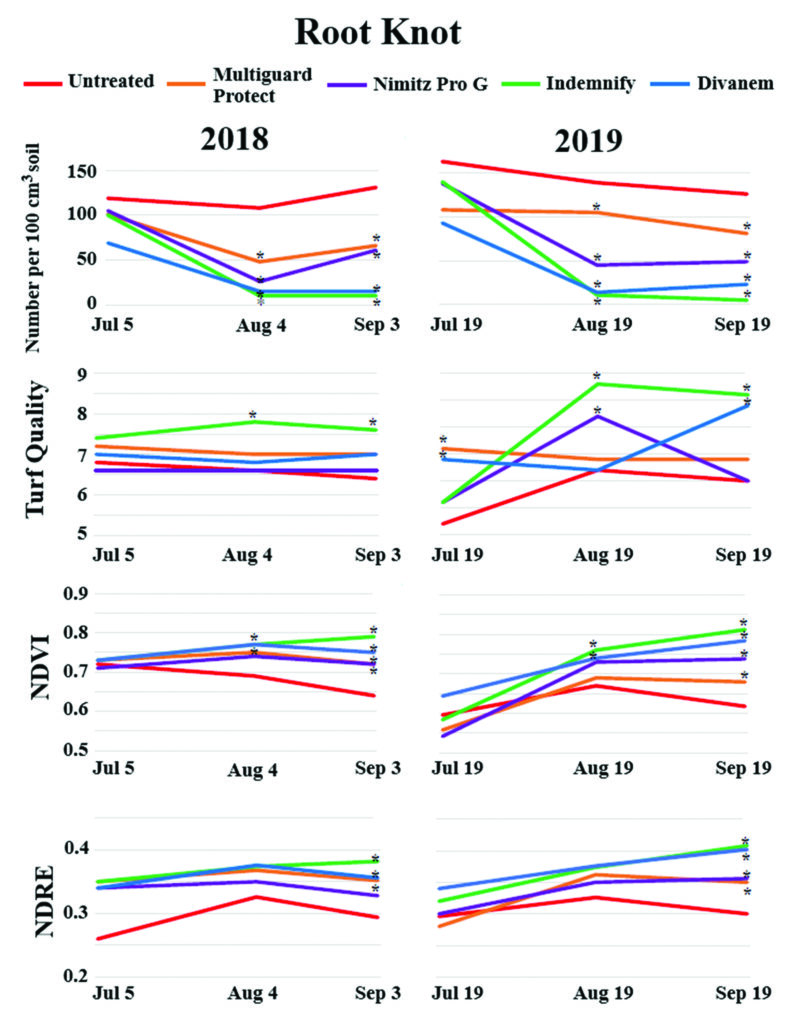
In the microplots, all four nematicides significantly reduced root-knot and sting nematodes within 30 days after treatment (Figure 4). For root-knot, Indemnify consistently produced the greatest turf improvement. In 2019, Nimitz Pro G also performed well early in the season, while Divanem matched Multiguard Protect visual quality at 60 days after treatment (DAT). All nematicides improved NDVI values, an indicator of canopy greenness and density, particularly at 60 DAT. The NDRE measurements, which reflect chlorophyll content, also increased under several nematicide treatments.
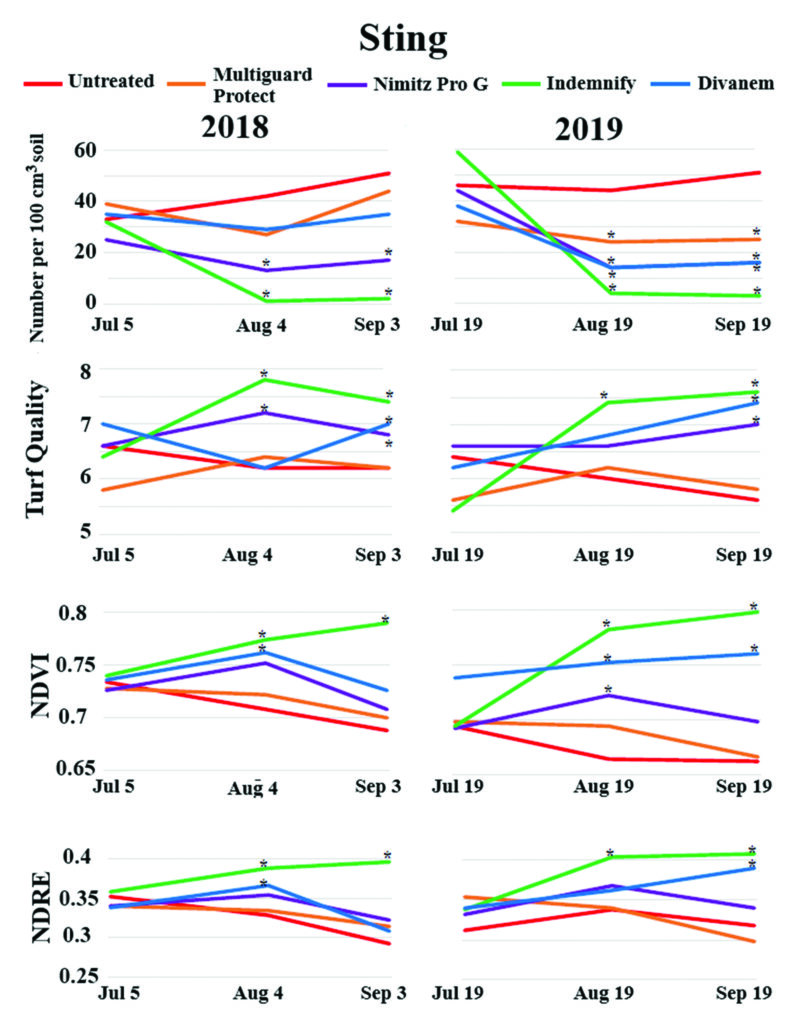
In the sting nematode trials, Indemnify and Nimitz Pro G were again the top performers, significantly reducing nematode populations in both years (Figure 5). Divanem also improved turf quality and NDVI in several evaluations, while fluopyram frequently yielded the highest NDRE readings, showing greater turf vigor and chlorophyll recovery after treatment.
Golf course field testing on putting greens in 2019 confirmed these trends under real-world conditions. Five nematode genera were identified, including sting, root knot and lance, with total population densities reduced by all nematicides at 28, 56 and 84 DAT (data not shown).
Indemnify produced the highest turf quality and NDVI/NDRE values throughout the trial, followed by Divanem. Nimitz Pro G also enhanced NDRE at several evaluation dates. Remote imagery revealed that nematicide-treated plots maintained denser, greener turf canopies compared to untreated controls.
Linking remote sensing and nematode pressure
Data analysis showed strong negative correlations between nematode density and both NDVI and NDRE — as nematode numbers rose, spectral indicators of turf health declined (Figures 4 and 5). In contrast, turf quality, NDVI and NDRE were all positively correlated with one another, validating the reliability of these digital tools.
These results support earlier studies demonstrating that unmanned aerial systems (UAS) and multispectral sensors can detect turf stress from nematode damage before it is visually evident. NDVI and NDRE captured subtle canopy changes linked to nematode suppression more precisely than traditional ratings.
Subscribe to Golfdom



If you enjoyed this article, subscribe to Golfdom to receive more articles just like it.