




Super Science: Fungicide timing for spring dead spot
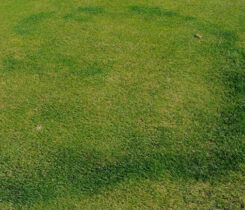
Spring dead spot (SDS) (Ophiosphaerella spp.) is a damaging disease of bermudagrass. Fungicides are an effective tool for management of the disease, but optimal application timing can be challenging.

Spring dead spot is more severe on warm-season turfgrasses in areas with cold-induced dormancy. The inconsistency of fungicide applications arises from relying solely on calendar-based applications instead of considering both calendar date and soil temperature.
Wendell Hutchens, Ph.D., and colleagues at Virgina Tech University conducted research to provide information on proper fungicide application timing for spring dead spot suppression in bermudagrass. Their findings show that applications made in the fall when soil temperatures are near 55 degrees F (13 degrees C) provide the greatest disease control.
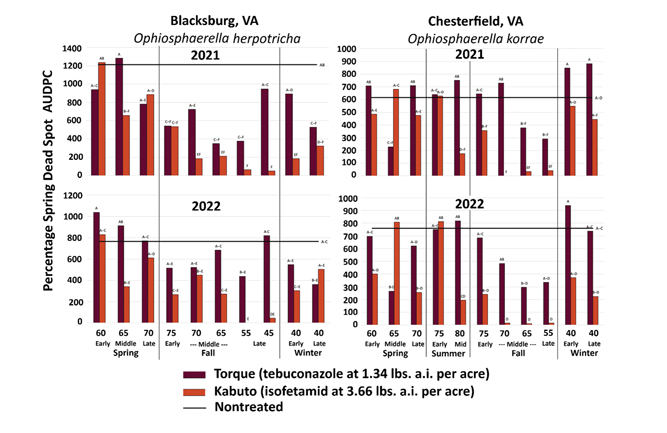
The field study was conducted at three separate hybrid bermudagrass locations in Virginia to determine the optimal soil temperature and timing for SDS suppression with Nufarm’s Torque (tebuconazole) and PBI-Gordon’s Kabuto (isofetamid). They applied Torque (1.34 pounds a.i. per acre) and Kabuto (3.66 pounds a.i. per acre) at 11 different timings throughout the year based on soil temperatures at a 0- to 4-inch depth. Plots were assessed for SDS severity in the spring and early summer of 2021 and 2022.
Results for two of the three locations (Blacksburg and Chesterfield, Va.) are summarized in Figure 1. Fall applications when soil temperatures were 55 degrees F consistently provided the best SDS suppression. Fungicide applications for spring dead spot are determined by considering both soil temperature and the time of year. The most effective fungicide application timing varies between the Ophiosphaerella species that cause spring dead spot.
For more information, you can access the entire open access article from Crop Science.
Reference
Hutchens, W. J., Booth, J. C., Goatley, J. M., Roberson, T. L., & McCall, D. S. (2025). Optimizing fungicide application timing for spring dead spot based on soil temperature and season. Crop Science, 65, e21411. https://doi.org/10.1002/csc2.21411
Subscribe to Golfdom



If you enjoyed this article, subscribe to Golfdom to receive more articles just like it.